
Frederick Otu-Larbi (Lancaster Uni), Benjamin Neimark (Queen Mary Uni), Patrick Bigger (Climate and Community Project, USA), Linsey Cottrell (Conflict and Environment Observatory, UK), Reuben Larbi (Lancaster Uni)
- ❖ The projected emissions from the first 120 days of the Israel-Gaza conflict were greater than the annual emissions of 26 individual countries and territories.
- ❖ If we include war infrastructure built by both Israel and Hamas, including the Hamas’ tunnel network and Israel’s protective fence or ‘Iron Wall,’ the total emissions increase to more than over 36 individual countries and territories.
- ❖ The carbon costs of reconstructing Gaza are huge. Rebuilding Gaza will entail total emissions figure higher than the annual emissions of over 135 countries, putting on them par with that of Sweden and Portugal.
- ❖ Our upper estimate on all pre-/post-war activities are comparable to the burning of 31,000 kilo tonnes of coal– the amount of which can power about 15.8 coal-fired power plants in one year.
- ❖ The ad-hoc nature of these calculations point to the urgent need for mandatory military emissions reporting for both war and peacetime through the UN Framework Convention on Climate Change (UNFCCC).
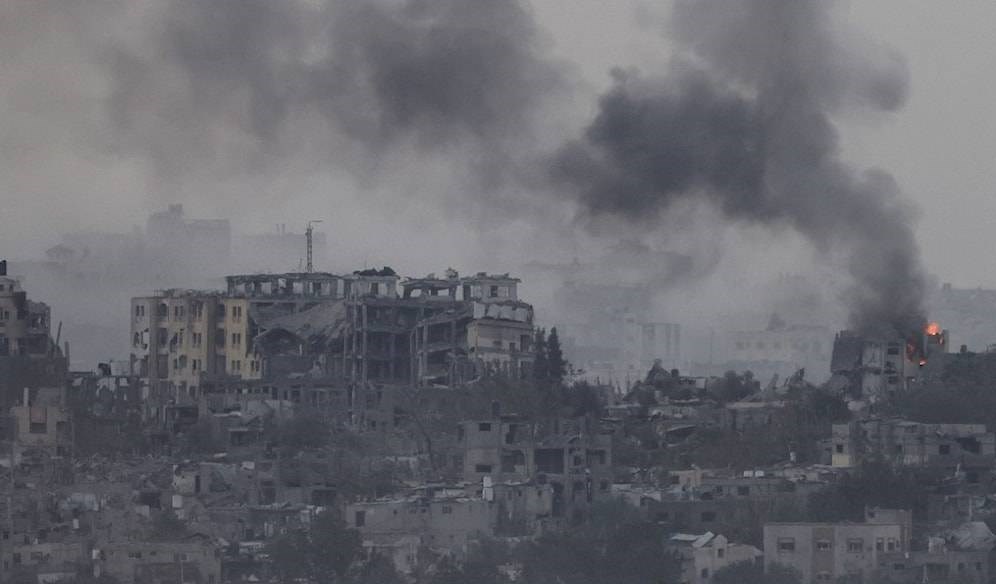
The decades-old conflict in Israel and Palestine has reached an inflection point. Israel’s ground invasion of Gaza, following the horrific attacks by Hamas on October 7, 2023, shows no sign of letting up, and after months of unprecedented bombardment the human costs of the conflict are reaching scales previously unseen in the region. The numbers are staggering; as of February 2024, over 35,000 in Palestine and 1,139 in Israel have died, and over 100 Israelis and foreign nationals still held hostage by Hamas. Estimates place 54-66% of Gaza’s buildings — homes, schools, mosques, hospitals — as destroyed or damaged. The Bank of Israel, initial forecasts of the future financial cost to Israel expected to reach up to $50 billion, including rebuilding Gaza. The World Bank has placed an estimated $18.5 billion price on the damages to physical structure alone.
While the Israel-Gaza conflict was closely monitored at the UN Framework Convention on Climate Change (UNFCCC) Conference of Parties (COP) 28 meetings in Dubai by delegates and civil society organisations, its climate dimensions were barely acknowledged. Prompted by the hosts, the links between conflict and climate change were included on the UNFCCC agenda for the first time. It is important to build on this post-COP momentum to highlight gaps in current military emissions reporting,10 while pushing for immediate cuts to military emissions as an economic sector where governments have direct authority to manage operations. According to the United Nations Environmental Programme’s most recent Emission Gap report, military emissions are ‘insufficiently accounted for’ by the UNFCCC, but even with incomplete data, researchers have found that militaries still account for almost 5.5% of global emissions. The data gaps clearly complicate estimations for key climate indicators. The global climate change indicators for 2023 show significant changes in just the three years since the IPPC 6th Assessment Report came out. Total annual global emissions were up to 54 G tonnes CO2, yet the method of estimating GHG emissions change did not take into consideration emissions due to military actions.
Within the turmoil of the current conflict are the less discussed, but vitally important, climate and wider environmental effects of the war. This omission is understandable as the world remains focused on the acute death and suffering. However, military operations remain an under-analysed dimension of the climate crisis that will worsen suffering on vulnerable communities and the wider region as the impacts of global warming intensify. Difficulty in monitoring and accessing information about combat operations is one of the major reasons for the limited literature on the climate impacts of war, a second, being the lack of rigorous methodologies to track them. In the following article, we seek to fill this gap in knowledge surrounding military emissions, and particularly emissions during war.
As far as we are aware, the Israeli military (IDF) has never reported emissions figures. No specific data on military fuel combustion emissions has been provided in Israel’s annual National Greenhouse Gas (GHG) Inventory to the UNFCCC, although requested under the reporting category 1A5, which should cover emissions from military fuel use…
Read more from the Original paper: https://www.researchgate.net/profile/Patrick-Bigger/publication/381196035_A_Multitemporal_Snapshot_of_Greenhouse_Gas_Emissions_from_the_Israel-Gaza_Conflict/links/6661948f85a4ee7261a90149/A-Multitemporal-Snapshot-of-Greenhouse-Gas-Emissions-from-the-Israel-Gaza-Conflict.pdf