Tackling global security risks in the second Trump era [Rethinking Security]

The following is an abstract from an article by Dr Stuart Parkinson on 13 January 2025 from https://rethinkingsecurity.org.uk/2025/01/13/tackling-global-security-risks-in-the-second-trump-era/

The return of Donald Trump to the US presidency undermines efforts to tackle urgent global security risks such as nuclear weapons and climate change. Dr Stuart Parkinson gives an overview of the problems and assesses how best to respond.

Global risks have been increasing for years. To name but some of the most extreme are the climate crisis, the potential for nuclear war, the breaching of numerous planetary boundaries, the increase in extreme inequality and poverty, the growing number of ‘conventional’ wars, disruptive technologies, and disease pandemics. Most, if not all, have a security dimension.

There’s plenty of evidence that the election of Donald Trump as US president for the second time will undermine progress in tackling virtually all of these.

This article focuses on two leading examples – the risk of nuclear war and the climate crisis – to highlight both the threats from Trump and the numerous opportunities to blunt his negative impact. One key element is the role of scientific community…

The Climate Crisis

Global climate change is already reaching critical levels. Climate scientists estimate that global carbon emissions will likely exceed the level necessary to breach the 1.5°C temperature target – as specified in the 2015 Paris Climate Agreement (PCA) – as early as 2027. Climate change-induced extreme weather is already wreaking havoc around the world – in the form of heatwaves, droughts, wildfires, major storms, floods, and crop failures – and things are set to get much worse. The probability is growing that we will soon pass critical ‘climate tipping points’, where change becomes rapid and irreversible. This includes die-back of the world’s coral reefs and the Amazon rainforest, melting of major ice sheets, and changes to major ocean currents. The impacts will be felt most acutely by the most vulnerable human communities, and are already contributing to a mass extinction of animals and plants.

Trump – a self-confessed climate denier – is therefore one of the last people the world needs as president of the world’s largest economy right now. His policies include withdrawing the United States from the PCA and dismantling national low carbon energy programmes. He supports an expansion of oil production in areas like the Alaskan Arctic, and a resumption of US exports of high-carbon liquified natural gas. New tariffs on imported goods are likely to push up the prices of low carbon technologies such as solar panels. His pick for Energy Secretary is Chris Wright, an oil and gas industry executive who endorses Trump’s extreme views and policies.

However, Trump will still face significant obstacles in trying to derail the low carbon transition now underway in the United States, let alone internationally.

  1. Competitiveness of renewables

Let’s start with energy. US coal use has been falling rapidly since its peak in 2007, due to poor economics and less polluting alternatives. Even during Trump’s first term, consumption fell 25%,[ii] despite his claims to support the industry. The latest data shows that consumption has fallen 55% below the peak. Likewise, US electricity generation from renewable sources expanded 34% despite Trump’s lack of support during his first term.[iii] Again, this growth followed the overarching trend, with cost playing a critical factor. The favourable economics of especially wind and solar power – with an increasing role for energy storage technologies – is improving year by year, meaning fossil fuels are likely to be replaced even more rapidly in future years.

  1. State and local activism

Indeed, much climate-related policy is decided and implemented at state level in the United States, and hence Trump’s ability to interfere will be even more limited. 23 states – representing over 50% of the US population – now have carbon reduction targets, with most aiming for net zero emissions by 2050 at the latest. President Biden’s Inflation Reduction Act put in place many support mechanisms for climate action, creating large numbers of jobs, so states that have benefitted are likely to oppose these changes both within Congress and through the courts.

  1. Price impacts of tariffs

Trump’s plans to bring in tariffs for imported goods are likely to have mixed effects on climate action. While there are justified concerns that these will slow the uptake of cleaner technologies such as solar panels and electric vehicles, there is widespread agreement among economists that the tariffs will lead to significant price rises for all US consumers. This will likely decrease consumption of a wide range of goods and energy use more broadly – and could well bring down carbon emissions.

  1. International cooperation and action

The response of other nations to Trump’s climate-related policies will be also critical. It is essential that other major economies quickly increase co-operation over their climate-related policies and research programmes. This will, for example, help enable them to submit much more ambitious climate targets to the UN by the next deadline in February. There are numerous international alliances focused on expanding renewables, improving energy efficiency, and cutting methane emissions, fossil fuel subsidies, and deforestation. Support for these needs to be strengthened. One important aspect is to improve trade between neighbouring nations, which will help shorten supply chains and hence reduce emissions. Measures targeting fossil fuel corporations and elite polluters could yield particularly large reductions.

The COP29 climate negotiations in early November – carried out in the shadow of Trump’s election – showed that nations could still reach agreement on numerous initiatives, ranging from international climate finance to the expansion of energy storage. However, ambition is still not close to where it needs to be. Climate-friendly governments, campaigners, and scientists will need to keep up the pressure for much stronger action.

While the chances of keeping global temperature change below 1.5°C may be vanishing fast, no effort should be spared to prevent every 0.1°C rise above that target. Each fraction of a degree would still represent huge numbers of lives lost and ecosystems devastated. Indeed, it is also essential that other wealthier nations increase their funding of climate adaptation measures in vulnerable communities.

Scientific evidence

Underpinning the dangers that Trump poses for global security risks is his disdain for scientific evidence and his willingness to spread disinformation.

One especially serious concern here is that he will start to dismantle US government scientific bodies and research programmes which don’t suit his agenda. This could also interrupt data collection on key issues from health to arms control to environmental protection. During his first term, he cut funding for NASA’s satellite-based Earth observation programmes – which are important for climate change research. This time around he could end the Global Change Research Program and dismantle the National Oceanic and Atmospheric Administration (NOAA). He could also cut crucial US funding for UN bodies, such as the UN Environment Programme (UNEP), World Health Organisation (WHO), and UN Educational, Scientific and Cultural Organization (UNESCO).

Again, it is essential for others – whether they be national governments, US bodies at the state level, or independently funded scientific organisations – to step into any voids as far as possible, whether by providing additional funds or hosting R&D programmes. We must also support individual scientists who resist attacks on evidence gathering. We cannot allow the incoming Trump government to subvert the research and data upon which robust policy-making depends.

While the situation looks grim on many fronts, there is much that can be done to reduce the negative impacts of a new Trump-led government – and the time to act is now.

International Peace Camp – Mon 14th to Fri 25th April 2025

XR Peace is supporting the Lakenheath Alliance for Peace (LAP). This is because militarism is a major cause of climate change and biodiversity loss.


LAP is organising an international peace camp that will take place from Monday 14th to Friday 25th April and will be followed by the first ever blockade of USAF Lakenheath on Saturday 26th April. The blockade is being held just after our peace conference so that the internationals attending the peace camp and conference and can more easily join in both.

We would like as many XR groups and individuals to join us. Please sign up at Lakenheath Alliance for Peace. The leaflet above can be found here.

More information on our Events & Actions page

Global Week of Action for Peace and Climate Justice

21–28 September 2024

The Arms, Militarism and Climate Justice working group is an informal network of researchers and activists committed to ending militarisation of the climate crisis.

They have been meeting regularly since 2021. Since 2022, their working group has been under the umbrella of the Global Campaign to Demand Climate Justice as they seek to build stronger links between the peace and climate justice movements.

They meet every other month to share information and analysis and to collaborate on joint areas of work including events and advocacy initiatives. https://climatemilitarism.org

Divest from War – Invest in Climate Justice

The first annual Week of Action for Peace and Climate Justice will address the links between war, militarism and climate injustice, promoting grassroots action and policy making for peace and climate justice. This year’s theme is divest from war – invest in climate justice!

A Multitemporal Snapshot of Greenhouse Gas Emissions from the Israel-Gaza Conflict

Frederick Otu-Larbi (Lancaster Uni), Benjamin Neimark (Queen Mary Uni), Patrick Bigger (Climate and Community Project, USA), Linsey Cottrell (Conflict and Environment Observatory, UK), Reuben Larbi (Lancaster Uni)

  • ❖ The projected emissions from the first 120 days of the Israel-Gaza conflict were greater than the annual emissions of 26 individual countries and territories.
  • ❖ If we include war infrastructure built by both Israel and Hamas, including the Hamas’ tunnel network and Israel’s protective fence or ‘Iron Wall,’ the total emissions increase to more than over 36 individual countries and territories.
  • ❖ The carbon costs of reconstructing Gaza are huge. Rebuilding Gaza will entail total emissions figure higher than the annual emissions of over 135 countries, putting on them par with that of Sweden and Portugal.
  • ❖ Our upper estimate on all pre-/post-war activities are comparable to the burning of 31,000 kilo tonnes of coal– the amount of which can power about 15.8 coal-fired power plants in one year.
  • ❖ The ad-hoc nature of these calculations point to the urgent need for mandatory military emissions reporting for both war and peacetime through the UN Framework Convention on Climate Change (UNFCCC).

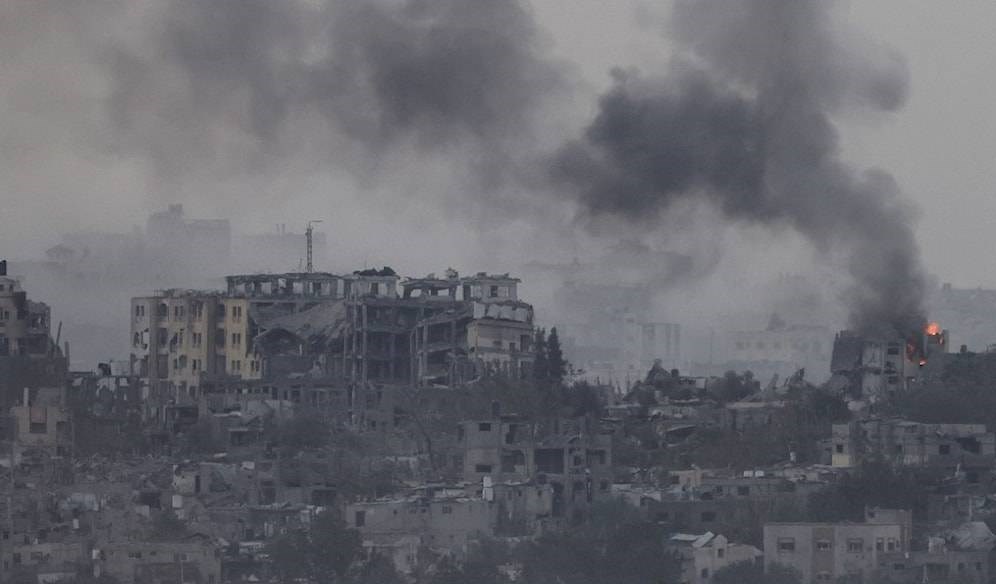
The decades-old conflict in Israel and Palestine has reached an inflection point. Israel’s ground invasion of Gaza, following the horrific attacks by Hamas on October 7, 2023, shows no sign of letting up, and after months of unprecedented bombardment the human costs of the conflict are reaching scales previously unseen in the region. The numbers are staggering; as of February 2024, over 35,000 in Palestine and 1,139 in Israel have died, and over 100 Israelis and foreign nationals still held hostage by Hamas. Estimates place 54-66% of Gaza’s buildings — homes, schools, mosques, hospitals — as destroyed or damaged. The Bank of Israel, initial forecasts of the future financial cost to Israel expected to reach up to $50 billion, including rebuilding Gaza. The World Bank has placed an estimated $18.5 billion price on the damages to physical structure alone.

While the Israel-Gaza conflict was closely monitored at the UN Framework Convention on Climate Change (UNFCCC) Conference of Parties (COP) 28 meetings in Dubai by delegates and civil society organisations, its climate dimensions were barely acknowledged. Prompted by the hosts, the links between conflict and climate change were included on the UNFCCC agenda for the first time. It is important to build on this post-COP momentum to highlight gaps in current military emissions reporting,10 while pushing for immediate cuts to military emissions as an economic sector where governments have direct authority to manage operations. According to the United Nations Environmental Programme’s most recent Emission Gap report, military emissions are ‘insufficiently accounted for’ by the UNFCCC, but even with incomplete data, researchers have found that militaries still account for almost 5.5% of global emissions. The data gaps clearly complicate estimations for key climate indicators. The global climate change indicators for 2023 show significant changes in just the three years since the IPPC 6th Assessment Report came out. Total annual global emissions were up to 54 G tonnes CO2, yet the method of estimating GHG emissions change did not take into consideration emissions due to military actions.

Within the turmoil of the current conflict are the less discussed, but vitally important, climate and wider environmental effects of the war. This omission is understandable as the world remains focused on the acute death and suffering. However, military operations remain an under-analysed dimension of the climate crisis that will worsen suffering on vulnerable communities and the wider region as the impacts of global warming intensify. Difficulty in monitoring and accessing information about combat operations is one of the major reasons for the limited literature on the climate impacts of war, a second, being the lack of rigorous methodologies to track them. In the following article, we seek to fill this gap in knowledge surrounding military emissions, and particularly emissions during war.

As far as we are aware, the Israeli military (IDF) has never reported emissions figures. No specific data on military fuel combustion emissions has been provided in Israel’s annual National Greenhouse Gas (GHG) Inventory to the UNFCCC, although requested under the reporting category 1A5, which should cover emissions from military fuel use…

Read more from the Original paper: https://www.researchgate.net/profile/Patrick-Bigger/publication/381196035_A_Multitemporal_Snapshot_of_Greenhouse_Gas_Emissions_from_the_Israel-Gaza_Conflict/links/6661948f85a4ee7261a90149/A-Multitemporal-Snapshot-of-Greenhouse-Gas-Emissions-from-the-Israel-Gaza-Conflict.pdf

ICAN report shows increased spending on Nukes

In its report “Surge: 2023 Global Nuclear Weapons Spending” the International Campaign to Abolish Nuclear Weapons shows in 2023, the nuclear-armed states spent $91.4B on their arsenals – equivalent to $2,898 a second.

ICAN won the Nobel Peace Prize in 2017. Profits associated with the nuclear arms industry was $7.9B in 2023 with at least $6.3 million spent on influencing governments and public opinion on nukes.

It estimated that 2,100 nuclear warheads (mostly US or Russia) were in a state of “high operational alert”

The biggest spenders were the US, China and Russia. UK spending was up 17% for the second year in a row to $8.1B.

SIPRI’s director Dan Smith said “Regrettably, we continue to see year-on-year increases in the number of operational nuclear warheads” and that the trend will likely accelerate in the coming years.

The head of ICAN, Melissa Parke, said the money spent on nuclear arms was more than what the World Food Programme needs to end world hunger.

https://www.icanw.org/global_nuclear_weapons_spending_surges_to_91_4_billion

Also see reports and video on DW News: https://www.dw.com/en/nukes-spending-rises-amid-growing-global-tensions-studies/a-69380756

Lakenheath Alliance for Peace Calling For Your Support

Visit the Lakenheath Alliance for Peace website

Calling For Your Support – LAKENHEATH ALLIANCE for PEACE

There are advanced plans to deploy American nuclear weapons to USAF/RAF Lakenheath, Suffolk. Infrastructure to house troops and to defend storage facilities and shelters is underway. Plus all sorts of other things we won’t know about. RAF Lakenheath is also the home to the USAF’s 48th Fighter Wing, the only unit in Europe, which operates both the F-15E Eagle and the F-35A Lighting II fighter aircraft. USA and Israel are also using UK air bases to move weapons to Israel to be used in their war against Hamas in Gaza, Palestine. Jet fighters in particular and militarism in general fuel climate change.

We must try and stop these weapons coming to USAF/RAF Lakenheath, or anywhere in the UK. We must raise awareness with the general public about what is happening. We therefore want to build an alliance of as many organisations and individuals as possible to create a powerful objection to US nuclear weapons returning to the UK.

Over 30 groups have already formed an alliance ‘Lakenheath Alliance for Peace’ including CND, Stop the War, WILPF, Greenham Women Everywhere, MAW, No to NATO, Trade Union Councils, Women in Black, Trident Ploughshares, XR Peace etc etc. More groups are joining every week. See https://lakenheathallianceforpeace.org.uk/about-us/alliance- organisations/

We are now inviting more groups to sign up with us. There are also many international peace activists interested in joining us. Please let us know as soon a possible if your group would like to join the Lakenheath Alliance for Peace as we need as many groups as possible to stop this nuclear escalation.

We launched LAP at the gates of USAF/RAF Lakenheath on March 26th delivering a letter to the base commander to demand No deployment of Nuclear Weapons at Lakenheath.

Our main event will start in Norwich on Saturday 13th July, when supporters will walk or cycle from Norwich to Lakenheath to raise awareness. Arriving on 15th July a camp will be set up and vigils, demonstrations and peaceful direct action will take place over the next week or so. Likely end of the camp will be 25th July depending on support.

WILL YOU SUPPORT AND JOIN US? In person; providing practical support; with publicity and raising awareness; getting demonstrations or meetings set up in your areas to coincide with any events or news coverage…ANYTHING to raise awareness about what is happening and that together we can stop US nuclear weapons from being based in the UK once again.

You can let us know of your support and be added to our mailing list by going to https://lakenheathallianceforpeace.org.uk/2024/03/16/sign-up/

With your help we are going to produce leaflets, banners and other informative materials to support what we are all doing.

WE HOPE WE CAN ADD YOUR LOGO to any materials we produce. The more organisations giving support from as wide a range of interests as possible, the better. This will give a coherent and strong statement about STOPPING the return of nuclear weapons to Lakenheath.

Please get in touch to ask for any further information and please let us know:-
a) Are you willing to be a named group in our Lakenheath Alliance for Peace (LAP)?
b) If so, please provide your group’s full name and email address, your mission statement and your logo if you have them.
c) Provide name & email of 1 person to represent your group and be the main communicator for your group who will be added to an email list for joint communications about LAP.

Best Wishes, Ali, Angie, Ginnie and Sue, lap@gn.apc.org

Hidden carbon costs of the “everywhere war”: Logistics, geopolitical ecology,and the carbon boot-print of the US military – Belcher et al

As climate change gathers pace, it is critical to assess how the world’s largest institutions contribute to global environmental change. In this paper, we analyse the United States military’s impact on the climate by exploring the hidden carbon costs of the “everywhere war” (Gregory, 2011).

Despite the Trump Administration’s announcement to withdraw from the 2015 Paris Agreement, the US military has long understood that it is not immune from the potential consequences of climate change (see US Department of Defense, 2014), nor has it completely ignored its own contribution to the problem.

The US military sees climate change as a “threat multiplier,” or a condition that will exacerbate other threats, and is fast becoming one of the leading federal agencies in the United States to invest in research and adoption of renewable energy (Gilbert, 2012). These investments include solar and biofuels, as well as reinforcing base infrastructure to mitigate the effects of sea‐level rise (Bigger & Neimark, 2017).

Nevertheless, the US military’s climate policy remains fundamentally contradictory. While the military confronts the effects of climate change, it remains the largest single institutional consumer of hydrocarbons in the world (Nuttall et al.,2017).


[download pdf]

Climate being wrecked by Global Military Spending and armed conflicts raging around the World

SIPRI: Global military spending surges amid war, rising tensions and insecurity

(Stockholm, 22 April 2024) Total global military expenditure reached $2443 billion in 2023, an increase of 6.8 per cent in real terms from 2022. This was the steepest year-on-year increase since 2009. The 10 largest spenders in 2023—led by the United States, China and Russia—all increased their military spending, according to new data on global military spending published today by the Stockholm International Peace Research Institute (SIPRI), available at www.sipri.org.

Military expenditure increases in all regions

World military expenditure rose for the ninth consecutive year to an all-time high of $2443 billion. For the first time since 2009, military expenditure went up in all five of the geographical regions defined by SIPRI, with particularly large increases recorded in Europe, Asia and Oceania and the Middle East. 

‘The unprecedented rise in military spending is a direct response to the global deterioration in peace and security,’ said Nan Tian, Senior Researcher with SIPRI’s Military Expenditure and Arms Production Programme. ‘States are prioritizing military strength but they risk an action–reaction spiral in the increasingly volatile geopolitical and security landscape.’

Military aid to Ukraine narrows spending gap with Russia 

Russia’s military spending increased by 24 per cent to an estimated $109 billion in 2023, marking a 57 per cent rise since 2014, the year that Russia annexed Crimea. In 2023 Russia’s military spending made up 16 per cent of total government spending and its military burden (military spending as a share of gross domestic product, GDP) was 5.9 per cent. 

Ukraine was the eighth largest spender in 2023, after a spending surge of 51 per cent to reach $64.8 billion. This gave Ukraine a military burden of 37 per cent and represented 58 per cent of total government spending.

Ukraine’s military spending in 2023 was 59 per cent the size of Russia’s. However, Ukraine also received at least $35 billion in military aid during the year, including $25.4 billion from the USA. Combined, this aid and Ukraine’s own military spending were equivalent to about 91 per cent of Russian spending.

USA remains NATO’s major spender but European members increase share

In 2023 the 31 NATO members accounted for $1341 billion, equal to 55 per cent of the world’s military expenditure. Military spending by the USA rose by 2.3 per cent to reach $916 billion in 2023, representing 68 per cent of total NATO military spending. In 2023 most European NATO members increased their military expenditure. Their combined share of the NATO total was 28 per cent, the highest in a decade. The remaining 4 per cent came from Canada and Türkiye.

‘For European NATO states, the past two years of war in Ukraine have fundamentally changed the security outlook,’ said Lorenzo Scarazzato, Researcher with SIPRI’s Military Expenditure and Arms Production Programme. ‘This shift in threat perceptions is reflected in growing shares of GDP being directed towards military spending, with the NATO target of 2 per cent increasingly being seen as a baseline rather than a threshold to reach.’

A decade after NATO members formally committed to a target of spending 2 per cent of GDP on the military, 11 out of 31 NATO members met or surpassed this level in 2023—the highest number since the commitment was made. Another target—of directing at least 20 per cent of military spending to ‘equipment spending’—was met by 28 NATO members in 2023, up from 7 in 2014.

China’s rising military expenditure drives up spending by neighbours

China, the world’s second largest military spender, allocated an estimated $296 billion to the military in 2023, an increase of 6.0 per cent from 2022. This was the 29th consecutive year-on-year rise in China’s military expenditure. China accounted for half of total military spending across the Asia and Oceania region. Several of China’s neighbours have linked their own spending increases to China’s rising military expenditure. 

Japan allocated $50.2 billion to its military in 2023, which was 11 per cent more than in 2022. Taiwan’s military expenditure also grew by 11 per cent in 2023, reaching $16.6 billion.

‘China is directing much of its growing military budget to boost the combat readiness of the People’s Liberation Army,’ said Xiao Liang, Researcher with SIPRI’s Military Expenditure and Arms Production Programme. ‘This has prompted the governments of Japan, Taiwan and others to significantly build up their military capabilities, a trend that will accelerate further in the coming years.’

War and tensions in the Middle East fuel biggest spending increase of past decade

Estimated military expenditure in the Middle East increased by 9.0 per cent to $200 billion in 2023. This was the highest annual growth rate in the region seen in the past decade. 

Israel’s military spending—the second largest in the region after Saudi Arabia—grew by 24 per cent to reach $27.5 billion in 2023. The spending increase was mainly driven by Israel’s large-scale offensive in Gaza in response to the attack on southern Israel by Hamas in October 2023. 

‘The large increase in military spending in the Middle East in 2023 reflected the rapidly shifting situation in the region—from the warming of diplomatic relations between Israel and several Arab countries in recent years to the outbreak of a major war in Gaza and fears of a region-wide conflict,’ said Diego Lopes da Silva, Senior Researcher with SIPRI’s Military Expenditure and Arms Production Programme. 

Military action against organized crime pushes up spending in Central America and the Caribbean

Military spending in Central America and the Caribbean in 2023 was 54 per cent higher than in 2014. Escalating crime levels have led to the increased use of military forces against criminal gangs in several countries in the subregion.

Military spending by the Dominican Republic rose by 14 per cent in 2023 in response to worsening gang violence in neighbouring Haiti. The Dominican Republic’s military spending has risen steeply since 2021, when the assassination of Haitian President Jovenel Moïse threw Haiti into crisis.

In Mexico, military expenditure reached $11.8 billion in 2023, a 55 per cent increase from 2014 (but a 1.5 per cent decrease from 2022). Allocations to the Guardia Nacional (National Guard)—a militarized force used to curb criminal activity—rose from 0.7 per cent of Mexico’s total military expenditure in 2019, when the force was created, to 11 per cent in 2023.

‘The use of the military to suppress gang violence has been a growing trend in the region for years as governments are either unable to address the problem using conventional means or prefer immediate—often more violent—responses,’ said Diego Lopes da Silva, Senior Researcher with SIPRI’s Military Expenditure and Arms Production Programme.

Other notable developments

  • India was the fourth largest military spender globally in 2023. At $83.6 billion, its military expenditure was 4.2 per cent higher than in 2022.
  • The largest percentage increase in military spending by any country in 2023 was seen in the Democratic Republic of the Congo (+105 per cent), where there has been protracted conflict between the government and non-state armed groups. South Sudan recorded the second largest percentage increase (+78 per cent) amid internal violence and spillover from the Sudanese civil war.
  • Poland’s military spending, the 14th highest in the world, was $31.6 billion after growing by 75 per cent between 2022 and 2023—by far the largest annual increase by any European country.
  • In 2023 Brazil’s military spending increased by 3.1 per cent to $22.9 billion. Citing the NATO spending guideline, members of Brazil’s Congress submitted a constitutional amendment to the Senate in 2023 that aims to increase Brazil’s military burden to an annual minimum of 2 per cent of GDP (up from 1.1 per cent in 2023).
  • Algeria’s military spending grew by 76 per cent to reach $18.3 billion. This was the highest level of expenditure ever recorded by Algeria and was largely due to a sharp rise in revenue from gas exports to countries in Europe as they moved away from Russian supplies.
  • Iran was the fourth largest military spender in the Middle East in 2023 with $10.3 billion. According to available data, the share of military spending allocated to the Islamic Revolutionary Guard Corps grew from 27 per cent to 37 per cent between 2019 and 2023.