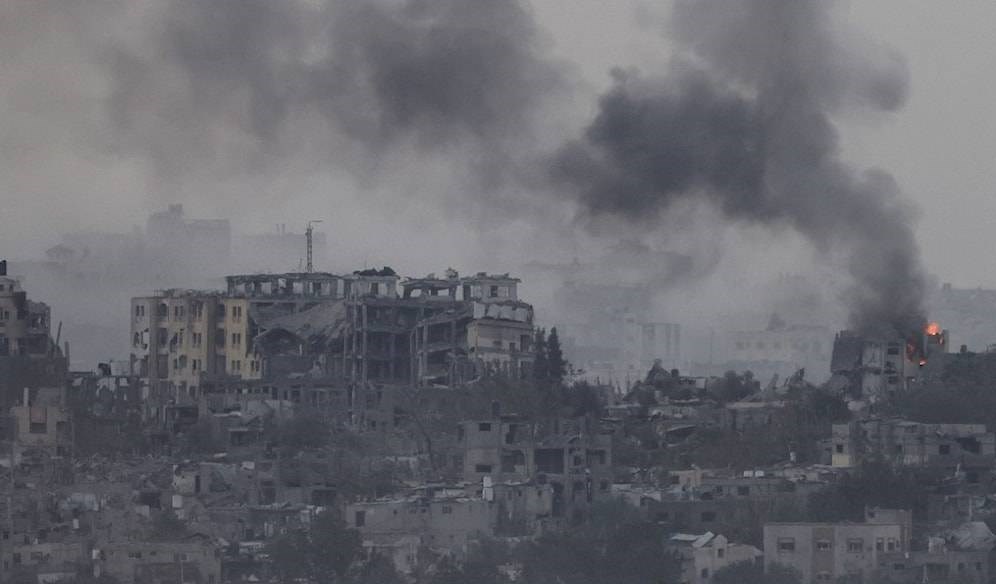
American warplanes are transiting through UK military bases en route to the Middle East. Why is Britain allowing it?
Anti-war campaigners have accused the British government of “playing down” its support for an illegal US attack on Iran as American warplanes continue to transit through UK military bases this week on the way to the Middle East.
The opaque decision-making, they say, has left much of the British public in the dark about the role the UK is playing and therefore unable to challenge what is happening.
Dozens of US warplanes have been able to transit through sites in Suffolk, with fighter jets going via Lakenheath while intelligence and refueling planes left from nearby Mildenhall.
“Where is the government’s announcement on this?” asked Sophie Bolt, general secretary of the Campaign for Nuclear Disarmament.
“The total secrecy and denial, refusing to confirm or deny – which is their standard response to anything going on ostensibly at a US military base – means that you can’t hold them to account.”
Last week, the Times, citing unnamed government sources, said that British prime minister Keir Starmer had blocked a request from US president Donald Trump to use RAF Fairford or British facilities at Diego Garcia for any attack on Iran.
Trump has signalled that the bases could be crucial to attacking Iran. RAF Fairford has a 10,000-foot runway and is the US Air Force’s only European airfield for heavy bombers.
Diego Garcia has a runway long enough for US B-2 stealth bombers that could bomb deep inside Iran.
But Starmer was said to have told Trump that such an attack would be in breach of international law, according to the Times.
The Ministry of Defence, however, declined to confirm that position when Declassified asked on Tuesday for the second time in a week.
Sunday 13thApril. 11 key people who were to stay for the full 2 weeks of the camp arrived early on Sunday morning to set up the camp. Spare tents for people coming without their own were quickly put up along with 3 workshop spaces and gazebos to provide shelter for well being, first aid and a welcome area. They were soon joined by a couple of people from Cambridge Woodcraft Folk who lent us their catering tent and Noni from XR who helped set up the kitchen. Roo and Kate, who were our cooks for the first week, started preparing our first meal of the camp.
The campsite was a wonderful venue with hot showers, toilets, electricity, fridges, and good mobile reception in a lovely part of the fen land. The bird watchers amongst us really enjoyed the beautiful morning chorus and the sightings of graceful avocets from the well positioned bird hide. The only downside was it took around 25 minutes to drive to Lakenheath for the vigils and events.
Monday 14th was the official start with an opening ceremony at the main gates of USAF Lakenheath. A large symbolic dove was held while a letter to the base commanders was read out by Jenn. Angie then tried to deliver it inside the base to personnel who would hand it to the commanders but was told letters could only be sent in by post and she was not allowed to walk to the reception office to hand it in. She said it would therefore have to be delivered by other means! (This was done during the War Crimes Day).
The 24/7 vigil area was established with banners and gazebos going up and the vigil itself started at 3pm and continued day and night throughout the 2 weeks of the camp. This presence showed our continuous concern about Lakenheath personnel and planes being involved in illegal war mongering, and also provided protection for our banners and equipment overnight. Almost as soon as the banners adorned the fence local drivers on the busy A1065 showed their support by honking their horns for peace.
Zoe held a workshop at the campsite on how to use a mobile phone to take and edit short videos for social media. Almost immediately, she started posting her own short social media videos for everyone to enjoy and continued this work throughout.
Tuesday 15th. Dave Rovics turned up and sang for us at the base and more banners went up. Zareen and her team of creatives had made banners and signs and other decorative peace symbols which went up over the next few days. Singers and choirs started to arrive at the campsite getting ready for the first of the Event Days.
Wednesday 16thApril The Political and Protest Choirs Day was very well attended with many people coming to join the camp just for a couple of days. Some eight groups/choirs were represented: Raised Voices (London); Oxford Sea Green Singers; Lefty Men Sing (Cambridge); Didcot Red Kites; Sheffield Creative Action for Peace; Common Lot Singers (Norwich) and Cambridge Climate Choir. They were joined by community singers from Weybourne and North Elmham who framed themselves as “Nameless from North Norfolk” as well as people who came to sing and play as individuals. Seize the Day ran a fantastic workshop at the Peace Camp in the morning, teaching six of their songs and around 70 singers sang at the gates of USAF Lakenheath in the afternoon. The sun shone on us, choir banners festooned the fence, spirits were high and we sung our hearts out. Some lovely connections were made and we spread the word about Campaign Choirs Network. Let’s keep up these connections!
In the evening, Robb Johnson and the Acoustic Irregulars (Robb, Fae and Sian) played – as well as Seize the Day (Shannon, Theo, Chris, Vicky, Dave and Mike) with choir members ‘joining the band’ for their second set! Apart from having an amazing evening, we raised almost £1,000 for LAP campaign funds. Huge thanks everyone for an evening to remember!
Thursday 17thApril Greenham Common Women’s Day. This was a reminder to us all that we faced this issue 44 years ago at USAF Greenham Common in Berkshire, and we won. We were now gathered at Lakenheath to face the issue again. In the morning Greenham Women leafleted and talked to people in the local town of Brandon, accompanied by The Sea Green Singers and Red Kites choirs from Oxfordshire singing peace songs.
At the USAF base in the afternoon, standing at the People’s Podium with a banner celebrating Greenham Common Women behind her and a poster declaring ‘Women are Sick of Wars, Weapons and Genocide’ in front, Ginnie reminded everyone of the history and legacy of the women who over 40 years ago started up the legendary peace camp. It was fitting that the fence of USAF Lakenheath had been decorated with figures echoing the 30,000 women who ‘embraced the base’ at Greenham Common one cold December day in 1982, and with banners and bunting made from yards of wool and fabric, hung like cobwebs; again a symbol resonant of Greenham. Women gathered to sing and reminisce, songs leapt to the lips as soon as someone started a tune, or a snatch of melody: You Can’t Kill the Spirit, We Circle Around, the Boundaries of the Earth etc.
After Ginnie spoke, women spontaneously rose to share their story and its impact on their lives. All had been empowered and the energy, the spirit, lives on in all that they have done and do. As one woman put it, ‘We must remember that we won’. For Greenham Common is indeed public land again, a wonderfully rich environment offering a joyful experience to thousands of families every year. This HAS TO BE the fate of USAF Lakenheath too!
Friday 18thApril Climate Day started with a ‘Peace and Climate Change’ workshop lead by Pete about how the military need for fossil fuels has shaped our world and the increased risk of conflict caused by climate change. Participants discussed ways forward. Activists gathered at the main gate from noon, where we “decorated” the fence with banners highlighting the link between militarism and climate change. We also tied our personal messages on peace doves onto the fence. There was a model Dodo at the gate to signal the extinction of species along with a skeleton atop it. Red Rebels stood in front of the Main gate showing how our movements and campaigns are linked.
There were local and national speakers, followed by discussion. Conservationist Dr Charlie Gardner spoke about the effects of both militarism itself and its link to climate change on natural habitats and how this also impacts on humans. Jen and Marijn from XR UK highlighted how militarism and climate change are catastrophically linked. Militarism and climate change feed each other – weapons-related activity causes significant emissions and as the effects of the climate and nature crisis continue to devastate the globe, the number of conflicts is only going to rise. They pointed out that over half of the most climate-vulnerable nations are already in conflict. Marijn emphasised how good it is to be in the alliance and the need for us to work together towards a world with peace and equality.
Saturday 19thApril New people arrived to join the camp for the weekend and took part in the vigils at the base and tasks around the campsite. Workshops were held by Rowland on not forgetting the West Bank and he worked alongside Susie and others to attach ties to the baby clothes and toys for the War Crimes Day. Nonviolence and De-escalation workshops were also held with Marcus and Christina. These had been offered each day.
Sunday 20thApril Most mornings Pilar managed to support the vigil as well as devising her theatre piece and songs. Camilla’s workshop involved campers learning and devising protest songs that were later performed at the camp’s evening circle. Junayd and volunteers rehearsed his poetry performance piece that was later performed at the base. Sue led a workshop on Women in Black. The nonviolence and de-escalation workshops took place as usual.
Monday 21stApril War Crimes and Genocide Day saw more than 50 people gathered on the opposite side of the Main Gate of USAF Lakenheath to the Vigil area and some distance away. To a solemn drum beat they walked very slowly, stopping from time to time to hang baby clothes and toys on the fence and lay symbolic baby bundles, white with blood seeping through or blue as if for burying, on the fence. These symbolised the thousands of babies and children murdered by the Israeli forces in Gaza. Placards were put on the fence with hands dripping in red, or saying ‘Blood on your Hands’, ‘What if this was your child?’ ‘School bags are for books not the body parts of children‘ or ‘I see humans but no humanity …… what is your RED LINE?’ Big pairs of eyes were also put on the fence symbolising our eyes watching this US military base involved in supporting the genocide in Gaza. The whole procession took around 2 hours in complete silence. 2 Red Rebels joined in with their tragic presence even affecting the many police watching.
At the People’s Podium, Angie explained the long history of humans using violence to control and exploit others, often perceiving it as justified by whatever god they worshipped. Starting with hunter and gatherers in Kenya 10,000 years ago, she quickly listed other genocides from Greek and Roman times to the more recent Armenian, Jewish, East Timorese, Rohingya and now present day genocides in Sudan and Gaza. She explained that the present genocide in Gaza is not done in our names but by political and military leaders, in league with massive corporations, in order to gain access to mineral resources, water and land in pursuit of huge profits that usually go to the 1%or rich people rather than the mass of ordinary people. Worst of all, wars continue because peace causes the value of shares in arms and so-called defence companies to drop. Angie quoted the Geneva Conventions and Genocide Acts and stated firmly that it is NOT anti-semitic to oppose genocide.
A statement by Carolyn Gelenter was then read out As the daughter of a refugee Holocaust Survivor from Poland Carolyn this added a Jewish voice against the genocide in Palestine, against nuclear weapons, against militarism and against war. Dr Mariam Karimi spoke as an NHS anaesthetist who had spent 4 weeks in Nasser hospital in Gaza last summer, and witnessed raids by the IDF, staff detained and disappeared, and the hospital closed with patients and staff still inside the building. Later a mass grave was found behind the hospital with patients buried with their hands tied behind their backs and with catheters and drips still attached to their bodies. Babies were also buried there. Mariam’s presentation was deeply moving and horrifying and a witness to the genocide unfolding there.
Mujahid Islam, currently working as a silicon chip designer, explained how as an activist with Stop The War Coalition he has been speaking out at meetings and conferences since 2001 against the invasion of Afghanistan and the wars in Ukraine and Gaza amongst others. He provided a contextual perspective.
Junayd, an actor-poet and writer, performed his poem, with the participation of a few volunteers. The refrain that we all joined in with was, ‘We return to an issue we’ve dealt with before, An issue pertaining to justice and war, Will the powerful lead us to violence and death, Or will the people of earth strive for the best?’
Camilla, musician and song writer, played her satirical song about the UK’s special trading relationship with genocidal Israel.
At the end of the speeches and performances, the War Crimes and Genocide letter to the Lakenheath Base Commanders and personnel on the base, that had been folded into paper planes, were flown into the base. They warned of all the personnel in the base being complicit in War Crimes and aiding and abetting genocide, all against international and national laws.
Tuesday 22ndApril – Democracy Day. Nuclear weapons characterise the brutality of our democratic deficit. We are constantly told that the way to effect policy is through our elected representatives. At no level of government have we, as local people, been asked for our consent, let alone our opinions on the nuclear weapons sited in our county.
In the morning, Cllr Tom Daly, East Suffolk reminded us that on earth day the government continued to promote its 3 priorities, billionaires, bulldozers and bombs, pleading poverty to excuse the impoverishment of those relying on decent welfare provision. Cllr Jan Davis, Broadland Cabinet member for Environmental Excellence, compared the annexation of Lakenheath’s ‘Little America’ with the US colonial past and likely future under the ignorant bully currently in charge. Jan had been given a tour of the base in his former role as an emergency planner, that included managing flood risk but not nuclear weapons. He said we’d be wrong to think that the people in charge know what they’re doing, and that the larger councils, coming with so-called devolution, will have even less local engagement. Cllr Rachel Smith-Lyte, East Suffolk called for more sympathy and less instruction from our leaders as we have enough knowledge and compassion to know that military requirements drive so-called civil nuclear power, as the economics don’t work and are a poor substitute for the genuine renewables that would keep us warm, reduce our bills and stimulate the economy. Cllr Gary Champion, Norwich, spoke of political disengagement and the need to empower young people to take part in democratic processes, particularly on the international stage, with many countries currently subject to democratic backsliding. The institutions in the UK, as was exemplified by Brexit, are exploited by populists and without democratic engagement. When many, young and old alike, receive their information based on tailored algorithms, opinions become polarised and clarity on issues of significance can be easily overlooked. The age of information ironically creates deficits in knowledge about key issues, such as the nuclear weapons at Lakenheath and the UK’s role in arms sales and war. All of the councillors who spoke were Green, though all Parties were invited. One Labour councillor came to listen but had been advised not to speak.
Callan Kemp from Unite Union then stressed the importance of building community, which is more than joining a union, which itself is more than voting. Joining a union gives a voice to people who do as they’re told 5 days a week. The voice calls for investment in people, diversification of skills and paying the bills
In the afternoon, more people spoke out. Baroness Natalie Bennett, former Green Party Leader, flagged up some ways that the world has changed. Of 9 planetary boundaries, 6 have already been passed – https://www.stockholmresilience.org/research/planetary-boundaries.html, The future will not look like the past. Centrist politics is dead, business as usual no longer viable. The far right seeks to control an apocalyptic narrative, but we can seize the initiative to one of a world sorted out. The UK has 1% of nuclear weapons, but could have huge positive impact by signing up to the TPNW. A privilege worth being in the House of Lords for, is the ability to look a minister in the eye and ask about AUKUS, essentially an arms trading partnership between Australia, UK and US. We do not have to accept this, or Trump’s bases or Trump’s control.
Jess Townsend, co-founder of XR, looked at getting better leadership from our MPs. She described the corporate capture of our laws, administration, regulation, ‘news’, data, myths and scapegoats, versus the public interest, aka, us. She recommended everyone to check out Carole Cadwalladr on the Architecture of Authoritarianism. Jess then led an interactive session encouraging people to engage with their MPs over different views and scenarios, stressing the importance of well-placed engagement.
Phil Laurie, speaking for Defend our Juries, gave a perfect example of corporate capture in the appointment of oil/arms industrialist Lord Walney as the Government’s advisor on extremism. Another is the decision by some judges to disallow defendants to use the necessity defence or even state their motivation, and to mislead juries about their rights and responsibilities. Activists know the importance of their role in holding decision-makers to account, and so do those wishing to avoid accountability. Phil Laurie described the change in protest scenery in the last 2 years since the 2023 Public Order Act, and 2024 Criminal Justice Act, under which people have been sentenced to 5 years for a zoom meeting. The law is administered particularly harshly toward people protesting for Palestine, animal rights and climate safety.
A message of support arrived from the Nuclear Free Local Authorities, who kindly wrote a briefing on how to engage local government on nuclear issues.
At the campsite Frits from Belgium talked about a different way of protesting – picnicking & digging for peace, and Camilla Saunders shared her research on divisions of the octave – music, colonialism and women.
Wednesday 23rdApril Faith Day – the event brought together people of different faith traditions, each with a concern about the threats to life, and our responsibilities to protecting creation, whatever we mean by that. It was diverse, welcoming and respectful.
Pax Christi England and Wales joined groups from different faiths for a peace vigil at the gates of Lakenheath airbase in Suffolk. The vigil began with liturgy led by the Iona community and included readings from the Qu’ran from local actor/poet Junayd Ul Islam, a special statement of support from Anglican Bishop David Walker brought by the Anglican Pacifist Fellowship, a Hindu prayer for peace, the Christian CND hymn and a Litany of Resistance led by London Catholic Worker. Quaker Recording Clerk, Paul Parker spoke on how our different faiths inspire protest and action against nuclear weapons before closing the vigil with a Quaker Act of Worship and the breaking of bread together.
Andrew Jackson from Pax Christi, who had helped co-ordinate the vigil, read extracts from Pope Francis’ many statements on nuclear weapons and disarmament as he had been so consistent in his and Catholic teaching’s opposition to them. Andrew said, ‘With his death, his words and exhortations seemed still more relevant and it felt powerful to be standing yards from where nuclear weapons might actually be stored and to speak out his declaration that it is not just the use of nuclear weapons that is immoral but their very possession.”
At the campsite various workshops took place including Sunghee and Kaia talking about resisting the US military at Gangjeong on Jeju Island in South Korea; Marc Morgan on promoting peace in a dangerous multi-polar world and Peter on Nukewatch and special flights and then on Drones. This was followed by Kate leading a discussion on international strategy.
Thursday 24thApril International Peace Conference Day was held in the village Hall at West Row, near to USAF Mildenhall. If anyone needed convincing that what’s happening at Lakenheath is a global problem, not a local one, they only had to attend the fantastic International Peace Conference, on day eleven of the LAP peace camp. In a packed local village community centre, activists and experts from across the globe came together to discuss: Analysing and Resisting US Nuclear Expansion. This was the most significant and extensive international anti-bases conference hosted here in Britain for as long as I can remember. So a huge thank you to everyone involved, including the facilitators who ensured really lively participation by all, and to those who kept us fed and refreshed throughout the day!
We were particularly honoured to welcome Koichi Toyoshima from Japan, Sung Hee Choi from the Jeju Island campaign in South Korea, and Joe Lombardo from UNAC in the USA, who had travelled across continents to be with us. There were great contributions too from bases across Europe, looking at what the bases do, and how we resist; others were looking at the wider global scenario, the impact of the bases, and the strategic way forward for our campaigns: Ludo de Brabander from Vrede in Belgium, Frits ter Kuile, a Catholic Worker from Amsterdam, Demetrios Hadjidemetriou, from Workers Democracy in Cyprus, Elio Pagani, from Abbasso la Guerra, Italy, Reiner Braun from IPB in Germany, Alain Rouy, from Le Mouvement de la Paix in France, and Soetkin Van Muylem, from Vrede in Belgium.
From Britain we welcomed Angie Zelter from LAP, Lynn Jamieson, from Scottish CND, Zareen Taj, from Cambridge Stop the War/CND, Bimal Khadka, from Medact, UK, Sophie Bolt, from CND, and Peter Burt from Drone Wars UK.
The conference couldn’t have been more timely or appropriate. New upgraded and enhanced bombs – the B61-12s – are coming to the US/NATO bases across Europe, at the worst possible time: when we need to dial down military tension across Europe, not ramp it up. These are the same bombs that we have been campaigning against for three years now: sharing experiences with others in the same situation was immensely valuable.
Of course the conference wasn’t just interesting and informative discussion and reports. Calls for action came out of the conference too, to help further coordinate global actions against NATO and militarism – one of the goals of our conference.
These calls echoed the European-wide initiative ‘Stop ReArm’, a coalition of peace and anti-militarist organisations, that many across Britain and Europe have joined, opposing the rise in militarism across the continent.
The conference agreed to support a week of coordinated action from Saturday 21 June to Saturday 28 June against NATO and the rise in militarism. The week of activity coincides with NATO’s 76th summit in The Hague in the Netherlands – on 24th and 25th June.
From 20th to 22nd June, many activists from across Europe and beyond, including many of those at the international conference, will be participating in a counter-summit of debate, planning and protest in The Hague, in the Netherlands. We hope that many will come to The Hague – and that many others will support the Lakenheath Peace Alliance vigil on Saturday 28 June as part of the week of action.
Friday 25thApril All day nonviolence trainings took place at the campsite in preparation for the blockade on the next day.
Meanwhile, at 9:30am fourteen women, intersex, non-binary and trans activists (FINT) – aged from 24 to 91 – held a blockade of the main gate of USAF Lakenheath, denouncing the deadly entanglements between militarism, climate change, authoritarianism and genocide. Ten activists were topless with chains around their wrists and tape over their mouths to expose the vulnerability and silencing faced by FINT people under systems of war, climate collapse, and oppression. Their bodies were painted with the words “Violence,” “Displacement,” “Brutality,” “Exploitation,” “Silencing” and “Oppression”. They stood hand in hand forming a powerful image blockading the vast military complex. War and climate change are both strongly linked to gender-based violence around the world. Four activists, including two of our international participants, stood behind them displaying flags and a banner saying “Break The Chain”.
The police agreed the activists could stand in the road for 10 minutes; however, when they left the police followed them to the safe vigil space, where they arrested Lucy, Chrissy and Cazzie, for indecent exposure. Chrissy had not been topless. The reason for arrest was then changed to “coming equipped” because of the symbolic chains. The three were taken to Bury St Edmunds police investigation centre, where they were charged with Obstruction of the Highway and released late that night.
Chrissy, a carer from Cwmbran, who was arrested for taking part in the action, said: “When so many people are seeing the impact of food insecurity, housing shortages, global warming, and the biodiversity crisis, it is an absurdity that everyday working people’s taxes are being spent on the murder of innocents and the further destruction of land which could provide food, housing and space for nature to thrive…… As an auntie and a carer, I cannot stand by and watch the military and fossil fuel industrial complex put profits over people. I have watched in horror the UK and US’s participation in war crimes and genocide in Gaza. Can we not evolve beyond this brutality? I believe we can.”
Cristina, journalist and action participant from London said: “I feel ill to think how the US and UK have orchestrated the bombing of Iran, Afghanistan, Syria, Serbia and now Palestine out of the beautiful UK countryside, having stored and dropped over 500 bombs on Syria alone. The loss of life, livelihoods, and permanent physical disabling of women and children are hard for people to connect with the beauty of Suffolk…. But this is not an innocent field, or even the RAF, it’s the US Air Force, and they are preparing to bring nuclear weapons back to the UK. This keeps no one safe, least of all the UK. Accidents have happened with weapons at Lakenheath before and they can happen again…… I would sacrifice the safety that clothing brings me to be bare-chested in front of the whole world if it gets people to pay attention and demand the US keep nuclear weapons out of Lakenheath”
Saturday 26thApril The Blockade went very well with coaches, minibuses, vans and cars coming from Oxford, Cambridge, Norwich, London, Leicester, Manchester and Birmingham. XR helped steward us, and brought their wonderful huge banners to add to the many flags and banners from the many campaign groups – Trident Ploughshares, CND groups, Quakers who led silent worships, Buddhists from Nipponzan Myohoji Pagodas who drummed for us, Communists singing the Internationale, XR Rhythms drummers, Red Rebels.
Over 250 people sat down outside the main gate and with police helping with safety no cars came out of the base or into the base from 12noon to 3.30pm. Throughout the 2 weeks, the LAP police liaisons, Angie, Marcus and Sue worked with the Suffolk Police to ensure safety and it was only when a point was reached during the Blockade, when the Suffolk Police felt the disruption had gone on long enough to ensure our right to protest but was now overstepping that time, that they made it clear they would arrest people. As silence descended again, the blockaders were asked to leave, and gradually they moved off the entrance roadway. By about 3.15pm 7 people had been arrested:- Ginnie – from Greenham Women Everywhere; Marie from Didcot and the Villages for Gaza; Jane from Trident Ploughshares; Marc from Mouvement pour une Alternative Non-Violente; Martin from Shrewsbury XR; Sateesh from Community Camp 4 Palestine and Jo from XR Peace. They were taken to Bury St.Edmunds Police Investigation Centre, bailed away from Lakenheath and told their case was being investigated and they should return on 2nd June to answer police bail. They had all been released by late evening and were picked up by supporters and brought back to the campsite.
During the 2 week camp there were between 30 and 90 people staying at the campsite or in homestays at any one time. Some people stayed in local hotels. Some came for a specific day or two to support a particular event day. A large number decided to stay for the whole of the 2nd week from Sunday 20th until Sunday 27th so as to include the Conference and the Blockade. Many different groups were involved in supporting the camp including Trident Ploughshares, XR Peace, XR UK, Quakers, Red Rebels, XR Rhythms UK, Nipponzan Myohoji Buddhists, Pax Christi, various CND groups, Stop the War, Women in Black, Aldermaston Women’s Peace Camp, Waveney Trades Union Council, East of England Communists to name just a few. And we were honoured and delighted to be joined by peace activists from Jeju in South Korea, Japan, Gran Canaria and from several of the European countries hosting US nuclear weapons.
Thanks to everyone for making it such an energising and successful camp. Please help to support our campaign until this base is closed down and returned to the people of the UK for peaceful use.
‘RAF’ Lakenheath has been involved in many of the recent wars for oil
The return of nuclear weapons to the base will escalate tensions when cooperation is needed more than ever
As climate change affects food and water supplies it is essential that we find peaceful means to deal with the problems not counterproductive armed aggression
The military, in particular the US Air Force, is a major contributor to world greenhouse gas emissions
Ownership or control of energy supply has always been a major source of power and wealth – from who owns the mill to oil barons and wars in the Middle East. This along with climate change makes energy one of the most important issues both nationally and internationally.
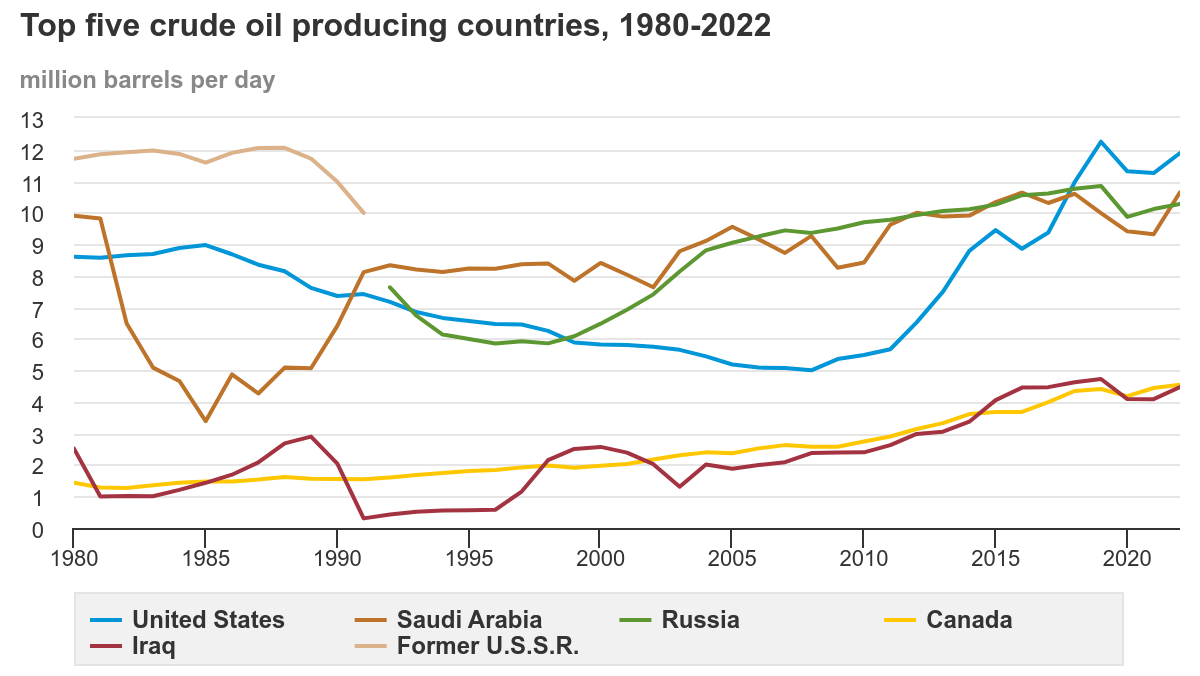
Oil and petroleum products explained Where our oil comes from
At present the fossil fuels still have enormous power. In the recent US election, it is estimated that fossil fuel industry spent $219 million to elect the new U.S. government1. In the UK it is little different with fossil fuel lobbyists, polluting industries and climate deniers donating £8.4 million to the Conservative Party since December 2019. Within the same period, they provided 92 per cent of the funds raised by the right wing Reform UK2.
The Russian Federation (and the Soviet Union beforehand3) also gains tremendous influence from its large supply of fossil fuels.
Using the control of fossil fuels as a weapon in the constant geopolitical contest between the two superpowers has been a source of a lot of wars and tensions.
Fossil Fuel Use
The military requires a large amount of energy – mainly fossil fuels. As General David Petraeus said in 2011, “Energy is the lifeblood of our warfighting capabilities.”4 In 2017 alone, CO2 emissions from the US military was up to 59 million tons which is more than many industrialized nations including Sweden and Switzerland. A large proportion of which is used by the air force5. F-35 combat planes do 0.6 miles per gallon6. A diesel car averages 46 miles a gallon.
Recent Lakenheath Operations
War planes from ‘RAF’ Lakenheath have been involved in many of the recent US wars including Iraq, Afghanistan, Libya and Syria. For example, in 2018 they flew over 2,000 missions against ISIL while dropping more than 500 bombs7. More recently they have been deployed many times to the Middle East to protect Israel8.
The base also carries out joint exercises with the Israeli Air Force9 and provided training for Israeli pilots at the base in the use of the Small Diametre Bomb (GBU-39/b) which has been used in Yemen10 and Gaza11 both of which have raised humanitarian concerns.
Cost
The world spends over $90billion on nuclear weapons every year12 and over $2,400billion on war in total13. This is more than the estimated $2,000billion a year needed to tackle climate change14.
Each of the 30 F-35A warplanes at ‘RAF’ Lakenheath cost over $80million15 and over $30,000 per flight16.
Nuclear Weapons
Nuclear weapons were deployed at the base since the 195017 but they were removed in 200818. However, the USAF are making preparations to bring B61-12 nuclear bombs back to ‘RAF’ Lakenheath19. The B61-12 is a tactical nuclear free fall bomb. Although they can be over three times more powerful the Hiroshima bomb they are much less powerful than some other modern nuclear weapons and more accurate, this makes them much more usable:
“This makes using nuclear weapons thinkable for the first time since the 1940s”20
Lakenheath Alliance for Peace
XR Peace is one of 53 organisations supporting the Lakenheath Alliance for Peace (LAP). XR Peace and LAP are committed to nonviolent direct action for a peaceful and non-threatening world. We demand that military resources are instead directed towards global peace and justice and the prevention of human caused climate change and biodiversity loss.
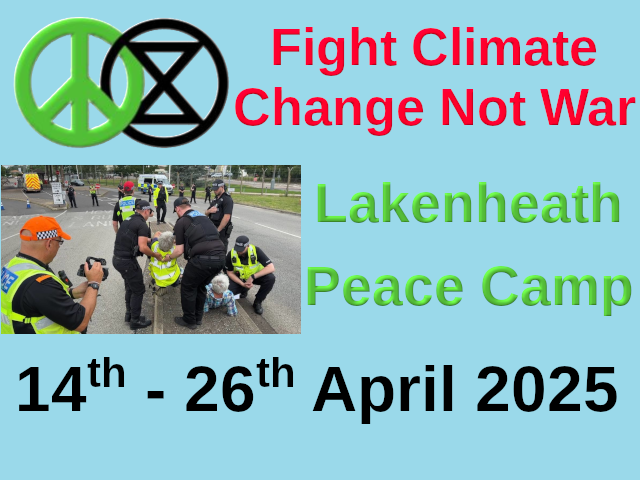
LAP is organising a 2 week protest camp from 14th to 26th April this year and we need you all to come and take part. Please sign up as you will then get our essential updates and be able to let us know when you can come.
The camp is about a half hour by car from the base itself but there will be a continuous 24/7 vigil taking place at the base gates and lots of activities and actions taking place there too.
Workshops that take place at the international peace camp are being added to the schedule all the time.
There is also an international peace conference on 24th April very close to the huge airbases of Lakenheath and Mildenhall and it will be followed by a large blockade of the base on Saturday 26th April
A fund-raising gig will take place during the first week of the camp at Bury St. Edmunds with Seize the Day and Robb Johnson.
If you come to the camp there will be time to plan your participation in the blockade and other actions, or we have trainers available if you get an affinity group together.
Fight Climate Change Not War
We can learn something useful from the escalating tensions and drive to war:
Money is not a problem it is political will – they can always find billions of pounds for war
Millions of people can be mobilized into the army and arms production
New technologies can be developed and deployed amazingly quickly
We need to raise our voice and our actions to say cooperation not conflict and fight climate change not war.
The return of Donald Trump to the US presidency undermines efforts to tackle urgent global security risks such as nuclear weapons and climate change. Dr Stuart Parkinson gives an overview of the problems and assesses how best to respond.
Global risks have been increasing for years. To name but some of the most extreme are the climate crisis, the potential for nuclear war, the breaching of numerous planetary boundaries, the increase in extreme inequality and poverty, the growing number of ‘conventional’ wars, disruptive technologies, and disease pandemics. Most, if not all, have a security dimension.
There’s plenty of evidence that the election of Donald Trump as US president for the second time will undermine progress in tackling virtually all of these.
This article focuses on two leading examples – the risk of nuclear war and the climate crisis – to highlight both the threats from Trump and the numerous opportunities to blunt his negative impact. One key element is the role of scientific community…
The Climate Crisis
Global climate change is already reaching critical levels. Climate scientists estimate that global carbon emissions will likely exceed the level necessary to breach the 1.5°C temperature target – as specified in the 2015 Paris Climate Agreement (PCA) – as early as 2027. Climate change-induced extreme weather is already wreaking havoc around the world – in the form of heatwaves, droughts, wildfires, major storms, floods, and crop failures – and things are set to get much worse. The probability is growing that we will soon pass critical ‘climate tipping points’, where change becomes rapid and irreversible. This includes die-back of the world’s coral reefs and the Amazon rainforest, melting of major ice sheets, and changes to major ocean currents. The impacts will be felt most acutely by the most vulnerable human communities, and are already contributing to a mass extinction of animals and plants.
Trump – a self-confessed climate denier – is therefore one of the last people the world needs as president of the world’s largest economy right now. His policies include withdrawing the United States from the PCA and dismantling national low carbon energy programmes. He supports an expansion of oil production in areas like the Alaskan Arctic, and a resumption of US exports of high-carbon liquified natural gas. New tariffs on imported goods are likely to push up the prices of low carbon technologies such as solar panels. His pick for Energy Secretary is Chris Wright, an oil and gas industry executive who endorses Trump’s extreme views and policies.
However, Trump will still face significant obstacles in trying to derail the low carbon transition now underway in the United States, let alone internationally.
Competitiveness of renewables
Let’s start with energy. US coal use has been falling rapidly since its peak in 2007, due to poor economics and less polluting alternatives. Even during Trump’s first term, consumption fell 25%,[ii] despite his claims to support the industry. The latest data shows that consumption has fallen 55% below the peak. Likewise, US electricity generation from renewable sources expanded 34% despite Trump’s lack of support during his first term.[iii] Again, this growth followed the overarching trend, with cost playing a critical factor. The favourable economics of especially wind and solar power – with an increasing role for energy storage technologies – is improving year by year, meaning fossil fuels are likely to be replaced even more rapidly in future years.
State and local activism
Indeed, much climate-related policy is decided and implemented at state level in the United States, and hence Trump’s ability to interfere will be even more limited. 23 states – representing over 50% of the US population – now have carbon reduction targets, with most aiming for net zero emissions by 2050 at the latest. President Biden’s Inflation Reduction Act put in place many support mechanisms for climate action, creating large numbers of jobs, so states that have benefitted are likely to oppose these changes both within Congress and through the courts.
Price impacts of tariffs
Trump’s plans to bring in tariffs for imported goods are likely to have mixed effects on climate action. While there are justified concerns that these will slow the uptake of cleaner technologies such as solar panels and electric vehicles, there is widespread agreement among economists that the tariffs will lead to significant price rises for all US consumers. This will likely decrease consumption of a wide range of goods and energy use more broadly – and could well bring down carbon emissions.
International cooperation and action
The response of other nations to Trump’s climate-related policies will be also critical. It is essential that other major economies quickly increase co-operation over their climate-related policies and research programmes. This will, for example, help enable them to submit much more ambitious climate targets to the UN by the next deadline in February. There are numerous international alliances focused on expanding renewables, improving energy efficiency, and cutting methane emissions, fossil fuel subsidies, and deforestation. Support for these needs to be strengthened. One important aspect is to improve trade between neighbouring nations, which will help shorten supply chains and hence reduce emissions. Measures targeting fossil fuel corporations and elite polluters could yield particularly large reductions.
The COP29 climate negotiations in early November – carried out in the shadow of Trump’s election – showed that nations could still reach agreement on numerous initiatives, ranging from international climate finance to the expansion of energy storage. However, ambition is still not close to where it needs to be. Climate-friendly governments, campaigners, and scientists will need to keep up the pressure for much stronger action.
While the chances of keeping global temperature change below 1.5°C may be vanishing fast, no effort should be spared to prevent every 0.1°C rise above that target. Each fraction of a degree would still represent huge numbers of lives lost and ecosystems devastated. Indeed, it is also essential that other wealthier nations increase their funding of climate adaptation measures in vulnerable communities.
Scientific evidence
Underpinning the dangers that Trump poses for global security risks is his disdain for scientific evidence and his willingness to spread disinformation.
One especially serious concern here is that he will start to dismantle US government scientific bodies and research programmes which don’t suit his agenda. This could also interrupt data collection on key issues from health to arms control to environmental protection. During his first term, he cut funding for NASA’s satellite-based Earth observation programmes – which are important for climate change research. This time around he could end the Global Change Research Program and dismantle the National Oceanic and Atmospheric Administration (NOAA). He could also cut crucial US funding for UN bodies, such as the UN Environment Programme (UNEP), World Health Organisation (WHO), and UN Educational, Scientific and Cultural Organization (UNESCO).
Again, it is essential for others – whether they be national governments, US bodies at the state level, or independently funded scientific organisations – to step into any voids as far as possible, whether by providing additional funds or hosting R&D programmes. We must also support individual scientists who resist attacks on evidence gathering. We cannot allow the incoming Trump government to subvert the research and data upon which robust policy-making depends.
While the situation looks grim on many fronts, there is much that can be done to reduce the negative impacts of a new Trump-led government – and the time to act is now.
LAP is organising an international peace camp that will take place from Monday 14th to Friday 25th April and will be followed by the first ever blockade of USAF Lakenheath on Saturday 26th April. The blockade is being held just after our peace conference so that the internationals attending the peace camp and conference and can more easily join in both.
Welcome to Episode 2 of Climate+ from Earthrise, a new show exploring the intersectionality of climate change and social justice in collaboration with Oxfam GB.
The Arms, Militarism and Climate Justice working group is an informal network of researchers and activists committed to ending militarisation of the climate crisis.
They have been meeting regularly since 2021. Since 2022, their working group has been under the umbrella of the Global Campaign to Demand Climate Justice as they seek to build stronger links between the peace and climate justice movements.
They meet every other month to share information and analysis and to collaborate on joint areas of work including events and advocacy initiatives. https://climatemilitarism.org
Divest from War – Invest in Climate Justice
The first annual Week of Action for Peace and Climate Justice will address the links between war, militarism and climate injustice, promoting grassroots action and policy making for peace and climate justice. This year’s theme is divest from war – invest in climate justice!
Frederick Otu-Larbi (Lancaster Uni), Benjamin Neimark (Queen Mary Uni), Patrick Bigger (Climate and Community Project, USA), Linsey Cottrell (Conflict and Environment Observatory, UK), Reuben Larbi (Lancaster Uni)
❖ The projected emissions from the first 120 days of the Israel-Gaza conflict were greater than the annual emissions of 26 individual countries and territories.
❖ If we include war infrastructure built by both Israel and Hamas, including the Hamas’ tunnel network and Israel’s protective fence or ‘Iron Wall,’ the total emissions increase to more than over 36 individual countries and territories.
❖ The carbon costs of reconstructing Gaza are huge. Rebuilding Gaza will entail total emissions figure higher than the annual emissions of over 135 countries, putting on them par with that of Sweden and Portugal.
❖ Our upper estimate on all pre-/post-war activities are comparable to the burning of 31,000 kilo tonnes of coal– the amount of which can power about 15.8 coal-fired power plants in one year.
❖ The ad-hoc nature of these calculations point to the urgent need for mandatory military emissions reporting for both war and peacetime through the UN Framework Convention on Climate Change (UNFCCC).
The decades-old conflict in Israel and Palestine has reached an inflection point. Israel’s ground invasion of Gaza, following the horrific attacks by Hamas on October 7, 2023, shows no sign of letting up, and after months of unprecedented bombardment the human costs of the conflict are reaching scales previously unseen in the region. The numbers are staggering; as of February 2024, over 35,000 in Palestine and 1,139 in Israel have died, and over 100 Israelis and foreign nationals still held hostage by Hamas. Estimates place 54-66% of Gaza’s buildings — homes, schools, mosques, hospitals — as destroyed or damaged. The Bank of Israel, initial forecasts of the future financial cost to Israel expected to reach up to $50 billion, including rebuilding Gaza. The World Bank has placed an estimated $18.5 billion price on the damages to physical structure alone.
While the Israel-Gaza conflict was closely monitored at the UN Framework Convention on Climate Change (UNFCCC) Conference of Parties (COP) 28 meetings in Dubai by delegates and civil society organisations, its climate dimensions were barely acknowledged. Prompted by the hosts, the links between conflict and climate change were included on the UNFCCC agenda for the first time. It is important to build on this post-COP momentum to highlight gaps in current military emissions reporting,10 while pushing for immediate cuts to military emissions as an economic sector where governments have direct authority to manage operations. According to the United Nations Environmental Programme’s most recent Emission Gap report, military emissions are ‘insufficiently accounted for’ by the UNFCCC, but even with incomplete data, researchers have found that militaries still account for almost 5.5% of global emissions. The data gaps clearly complicate estimations for key climate indicators. The global climate change indicators for 2023 show significant changes in just the three years since the IPPC 6th Assessment Report came out. Total annual global emissions were up to 54 G tonnes CO2, yet the method of estimating GHG emissions change did not take into consideration emissions due to military actions.
Within the turmoil of the current conflict are the less discussed, but vitally important, climate and wider environmental effects of the war. This omission is understandable as the world remains focused on the acute death and suffering. However, military operations remain an under-analysed dimension of the climate crisis that will worsen suffering on vulnerable communities and the wider region as the impacts of global warming intensify. Difficulty in monitoring and accessing information about combat operations is one of the major reasons for the limited literature on the climate impacts of war, a second, being the lack of rigorous methodologies to track them. In the following article, we seek to fill this gap in knowledge surrounding military emissions, and particularly emissions during war.
As far as we are aware, the Israeli military (IDF) has never reported emissions figures. No specific data on military fuel combustion emissions has been provided in Israel’s annual National Greenhouse Gas (GHG) Inventory to the UNFCCC, although requested under the reporting category 1A5, which should cover emissions from military fuel use…
In its report “Surge: 2023 Global Nuclear Weapons Spending” the International Campaign to Abolish Nuclear Weapons shows in 2023, the nuclear-armed states spent $91.4B on their arsenals – equivalent to $2,898 a second.
ICAN won the Nobel Peace Prize in 2017. Profits associated with the nuclear arms industry was $7.9B in 2023 with at least $6.3 million spent on influencing governments and public opinion on nukes.
It estimated that 2,100 nuclear warheads (mostly US or Russia) were in a state of “high operational alert”
The biggest spenders were the US, China and Russia. UK spending was up 17% for the second year in a row to $8.1B.
SIPRI’s director Dan Smith said “Regrettably, we continue to see year-on-year increases in the number of operational nuclear warheads” and that the trend will likely accelerate in the coming years.
The head of ICAN, Melissa Parke, said the money spent on nuclear arms was more than what the World Food Programme needs to end world hunger.