
The Dangers of Militarising the Climate Crisis
By Nick Buxton, published by the Transnational Institute (TNI). October 2021.
By Nick Buxton, published by the Transnational Institute (TNI). October 2021.
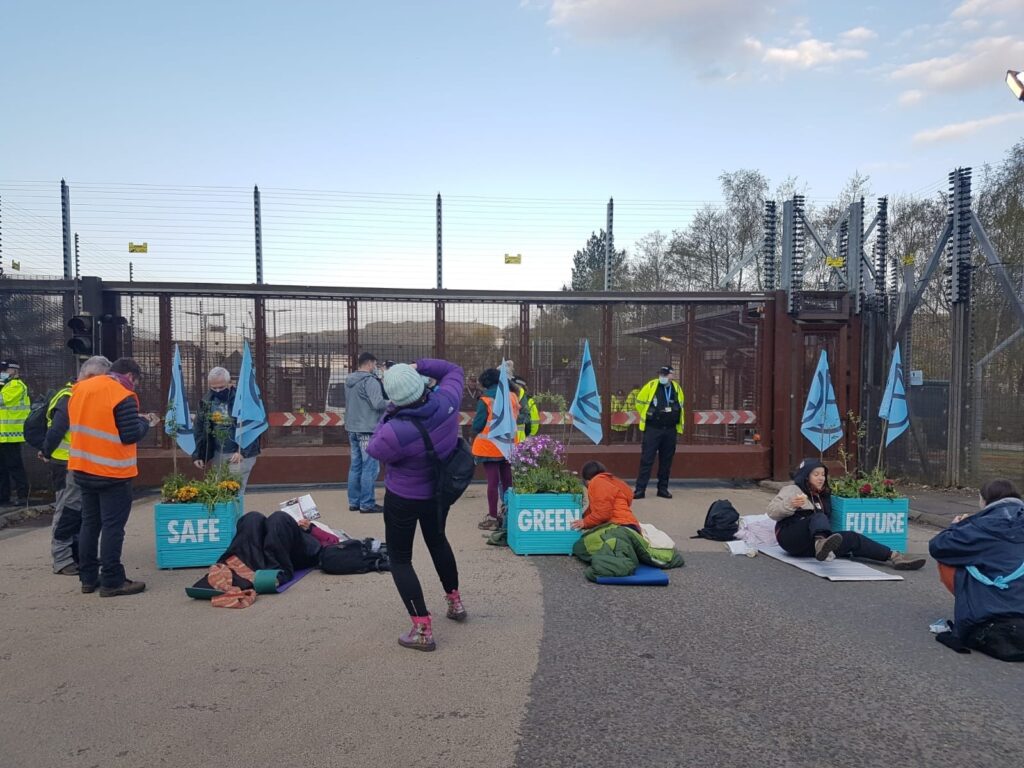
On Friday 30th April a group of XR Scotland rebels blocked Faslane’s North Gate to demand a ‘Safe, Green Future’.
Climate activists from Extinction Rebellion Scotland, collaborating with Trident Ploughshares and Faslane Peace Camp, blocked the North gate of the Faslane Naval Base, home of the UK’s nuclear submarines, for 11 hours.
The group placed three planters on the road containing plants and flowers painted with the words ‘Safe’, ‘Green’, and ‘Future’. A female Extinction Rebel is locked onto each planter so that they cannot be moved, preventing access to the base.
Meg Peyton Jones, biologist and XR Scotland activist, said: “We need to build a just, sustainable future, collectively with the whole world, rather than the UK lavishing hundreds of millions on its personal pile of nukes while the climate crisis and social injustice destroy the planet around us.”
The activists demand a future safe from the threat of nuclear weapons and environmental destruction. The Trident nuclear base is polluting the Clyde with toxic chemicals. The cost of updating and maintaining Trident during the systems’ 40 year lifespan is estimated to be up to £205 Billion of public money.
Sarah Krischer, 28, archaeologist and XR Scotland activist, said: “Nuclear weapons are an existential threat to the entire world. Stockpiling weapons with the ability to wipe out all life in order to appear tough does nothing to keep either the UK or any other country safe. The ongoing environmental degradation caused by uranium mining and nuclear testing continues to be felt, particularly among pacific island nations that are also the most threatened by climate change. We must come together to build a safe, more just future for all.”
Emergency vehicles could still access the site via the South gate. The group took precautions for Covid-19 safety precautions including social distancing and face masks.
The police after consulting the base commander rejected the offer to leave the activists in place until 7pm at which point they would unlock and leave. MOD and Police Scotland “cutting teams” removed them from the planter lock-ons and eventually cleared the road at 6.30pm. The three women were arrested for Breach of the Peace and released on bail with a court date later this month.
Meanwhile a solidarity vigil was held at Albert Gate of Devonport Dockyard in Plymouth.
Media coverage:

From XR Scotland:
“Three female rebels are locked on to planters of flowers outside of Faslane Naval Base this morning, home of the Trident nuclear weapons.
“Nuclear weapons are an existential threat to the entire world. Stockpiling weapons with the ability to wipe out all life in order to appear tough does nothing to keep the UK or any other country safe.
“The ongoing environmental degradation caused by uranium mining and nuclear testing continues to be felt, particularly among pacific island nations that are also the most threatened by climate change. On top of that it Faslane has been polluting the Clyde with toxic chemicals.
“As the ongoing Climate and Ecological Emergency threatens people and the planet, we must come together to build a safe, more just future for all people.
Follow XR Scotland on Facebook.

Angie Zelter, who was instrumental in setting up XR Peace, has written a remarkable account of her campaigning life and shared some of the lessons she has learnt from her actions in many different countries.
Heartfelt but clear, Activism for Life includes personal insights into mobilising for effective, sustainable nonviolent protest actions, dealing with security, police and courts and how seemingly different issues are actually closely intertwined.
She has designed and participated in nonviolent civil resistance campaigns and founded several innovative and effective campaigns. Her protests have been for a nuclear free world, that shares global resources equitably and sustainably while respecting human rights and the rights of other life forms. As a global citizen she has expressed her solidarity with movements all over the world. This has led to numerous arrests, court appearances and incarceration. Angie has been arrested around 200 times, mostly in the UK, and in Belgium, Canada, France, Germany, Gran Canaria, Holland, Israel/Palestine, Malaysia, Poland and South Korea. She has spent over two years in total in prison awaiting trials on remand or serving sentences. All for nonviolent resistance protests.
The author of several books, she is the recipient of the 1997 Sean McBride Peace Prize (for the Seeds of Hope Ploughshares action), the 2001 Right Livelihood Award (on behalf of Trident Ploughshares) and the Hrant Dink Prize in 2014. She continues to actively confront the abuses of corporations, governments and the military.
Watch the online Book Launch with Angie in conversation with PROFESSOR PAUL ROGERS, Emeritus Professor of Peace Studies at Bradford University.
You can buy this book from Trident Ploughshares, CND and all good bookshops.
The UN Treaty on the Prohibition of Nuclear Weapons(TPNW), adopted by 122 UN countries in 2017, will now enter into international law on 22 January 2021.

Nuclear abolition is necessary to prevent nuclear war and its extinction level threats to our environment and climate.
STOP CLIMATE CATASTROPHE and WAR [PDF]
This UN-negotiated Nuclear Treaty bans the use, production, possession, testing and proliferation of nuclear weaponsandmandates their verified elimination.
It also outlaws all activities that could enable anyone to threaten to use or acquire nuclear weapons, as it bans their possession, transfer, development, testing, stationing, stockpiling and deployment.
The Treaty forbids states parties and their residents to “assist, encourage or induce” anyone to commit any actions that are prohibited by the Treaty. This applies to companies as well as individuals, so let’s persuade them to divest from nuclear production.
These clear prohibitions cut through the fictions of nuclear deterrence, which for decades have been the main justification for NATO’s ‘nuclear sharing’ policies. The Treaty takes away any legitimacy claimed by the nuclear armed states – Britain, China, France, India, Israel, North Korea, Pakistan, Russia, the United States and their allies. No more can leaders hide behind false claims that peace and security necessitate military policies, perpetual threats and the capability to launch nuclear weapons of mass destruction and cause global extinction.
TO PREVENT NUCLEAR WAR, BRITAIN MUST JOIN THE BAN TREATY AND GET RID OF TRIDENT
HUMANITARIAN IMPERATIVES AND OBLIGATIONS
The Treaty’s preamble describes the humanitarian reasons for banning and eliminating nuclear weapons, explaining: “the catastrophic consequences of nuclear weapons cannot be adequately addressed, transcend national borders, pose grave implications for human survival, the environment, socioeconomic development, the global economy, food security and the health of current and future generations, and have a disproportionate impact on women and girls, including as a result of ionizing radiation…“
The Nuclear Prohibition Treaty also requires the elimination of all nuclear arsenals and provides the principles and pathways to get rid of the weapons safely and securely.
What does this mean for Britain? Read PDF Briefing
What can we doin the Covid Lockdown?

At about 6.30am, before dawn, a coalition of XR groups blockaded the vast MoD centre in north Bristol. Around forty activists from XR Bristol, Christian Climate Action, XR Peace and others unloaded wooden towers and a tripod to seal off all three vehicle entrances. Banners were strung across the roads and people clipped their arms into lockon tubes.
The date chosen was the fifth anniversary of the Paris Agreement pledging to keep climate changebelow1.5 degrees Celsius.
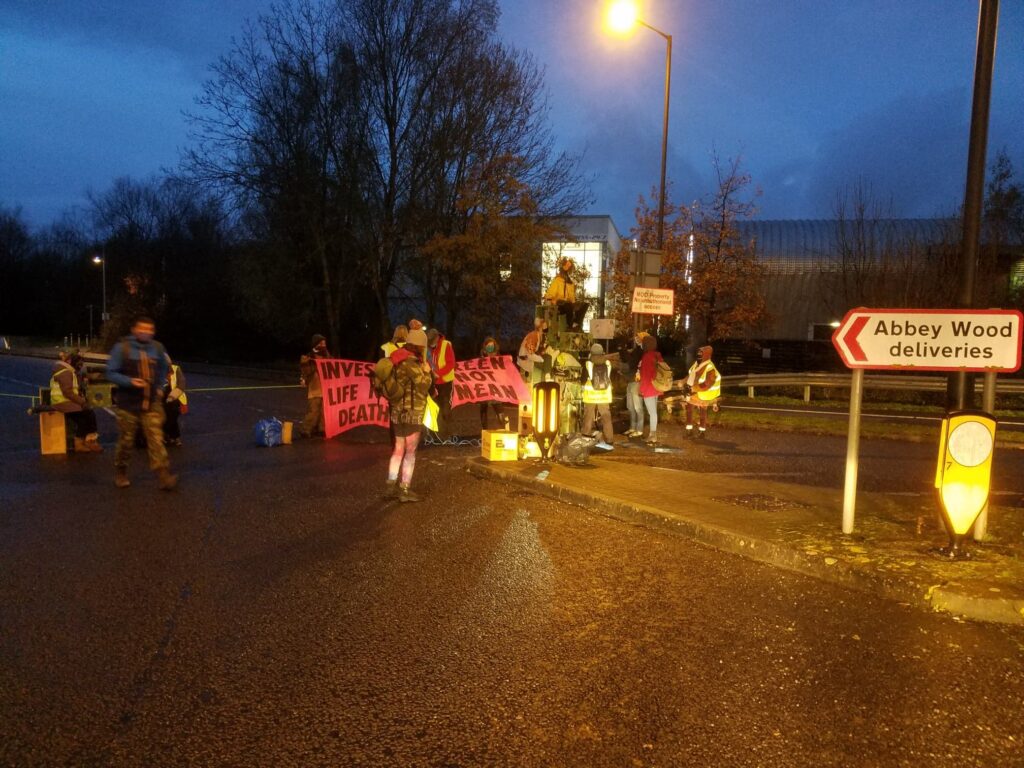
The blockade drew attention to what the protestors describe as the government’s “dangerously inadequate response” to the climate emergency. The Government has just committed £24 billion to military spending over the next 4 years, yet only £16 billion to their Climate Plan
Protester Reverend Sue Parfitt of Christian Climate Action, said “I don’t believe the answer to the ‘aggravated threats to international peace and security’ is to develop more sophisticated weapons. “We have to spend the money that’s needed on climate action. If we fail on this, the results will be unimaginable suffering.”

Sita Ruskin, of Bristol Extinction Rebellion, said “We’re here to say to our government: spend our money on combatting climate change – not on putting weapons into combat. Failing to take action on climate change is what will fuel war. It’s predicted that conflicts could increase by 10% to 20% for every half degree Fahrenheit increase in global temperatures.”
Police moved in to clear protesters by late morning. Quaker Gaie Delap and Reverend Sue Parfitt were arrested for obstruction of the highway and released later in the day. There was traffic disruption around the site for the rest of the day.

https://www.bristolpost.co.uk/news/bristol-news/extinction-rebellion-blockade-mod-abbey-4787780
Further information can be found at the new XR Peace Bristol facebook page www.facebook.com/xrpeacebristol/
Background information on the arms industry in north Bristol at https://bristolagainstarmstrade.wordpress.com/
Link to video of Interview about the shocking war machine in north Bristol https://www.facebook.com/rowland.dye/videos/10158574824296955
Rebecca Johnson, 28 Oct 2020, from OpenDemocracy.net
From the moment two atomic bombs killed two hundred thousand people in two split seconds over Hiroshima and Nagasaki seventy-five years ago, nuclear weapons have caused nightmares, environmental contamination, self-serving myths and abuses of power.
What will change now that the 2017 Treaty on the Prohibition of Nuclear Weapons (TPNW) is on the threshold of making nuclear weapons internationally illegal?
See also:
Church leaders urge UK government to sign UN anti-nuclear treaty (Guardian, 15 Nov 2020)
Treaty to ban nuclear weapons made official with 50th UN signatory (Guardian, 25 Oct 2020)
It is significant that the 90 day countdown to the legal entry into force of this multilateral nuclear disarmament Treaty was triggered by three nations (Honduras, Jamaica and Nauru) from the Global South. Symbolic too, that this occurred in time for the 50th ratification to be deposited with the UN Secretary General on 24 October, the 75th anniversary of the founding of the United Nations .
This Treaty Prohibiting Nuclear Weapons was brought about by “We the Peoples“, in direct opposition to the wishes of the nine nuclear armed governments, who desperately tried to stop the Treaty as negotiations opened in the UN General Assembly with rules that were developed by the UK and others to achieve the Arms Trade Treaty a few years earlier.
The UN rules ensured that all governments were invited to the table and no-one was given the power to veto. That made it possible for this Treaty to be negotiated and adopted by an overwhelming majority of states.
When I started writing a series of contemporaneous articles for openDemocracy on feminist approaches to security and disarmament in 2010, the International Campaign to Abolish Nuclear Weapons was a little known project of anti-nuclear doctors and activists in Australia. Treaty negotiations were controlled by a handful of governments that possessed nuclear weapons and wanted to keep control of the associated power and technologies for their own use.
The security and needs of the majority of nations who had decided to forego these weapons of mass extinction were barely taken into account.
Seventy years of campaigning by Japanese Hibakusha, such as Setsuko Thurlow and survivors of nuclear testing and colonialism, as well as generations of doctors, scientists and peace activists, culminated in UN ‘open-ended’ talks from 2013 that enabled far more people and governments to discuss how best to prevent the catastrophic consequences and risks of nuclear use and war. These in turn led to UN negotiations in 2017 that upended the privileges and assumptions of cold war arms control and made inroads into the nuclear club’s macho fiefdom.
Unable to block the negotiations or veto the Treaty, the nuclear armed states staged a boycott. Some, including three members of the UN Security Council, lined up their ambassadors in a weird demonstration outside the UN General Assembly as their colleagues from other countries streamed into the hall to begin the serious business of banning nuclear weapons.
Treaty negotiations were controlled by a handful of governments that possessed nuclear weapons and wanted to keep control of the associated power and technologies for their own use.
Three years later, we are celebrating that the Treaty Prohibiting Nuclear Weapons will become international law on January 22, 2021.
Making human security the objective of negotiations, instead of privileging military-industrial interests, has resulted in a powerfully different Treaty, based on humanitarian law and feminist security principles.
The preamble clearly sets out the shared security interests of the world’s peoples:
“… the catastrophic consequences of nuclear weapons cannot be adequately addressed, transcend national borders, pose grave implications for human survival, the environment, socioeconomic development, the global economy, food security and the health of current and future generations, and have a disproportionate impact on women and girls, including as a result of ionizing radiation…”
This leads to the core prohibitions on acquiring, developing, manufacturing, testing, deploying, transferring, possessing and using nuclear weapons. It is stipulated that everyone who is bound by the Treaty must also support its full implementation and avoid assisting, inducing or encouraging anyone else to violate its provisions in any way.
Having chosen to boycott the negotiations, the nuclear armed states complain that the Treaty is “dangerous” and doesn’t take their interests into account. In a last ditch derailing attempt, the Trump administration sent a letter and talking points to many governments. Arrogantly describing national decisions to join the Treaty as a “strategic error”, the letter tried to pressure them to pull out.
Among its talking points the US repeats its discredited accusation that the new Treaty undermines the 1968 Non-Proliferation Treaty (NPT) and complains that the text does not fully determine how its prohibitions and provisions will be verified and implemented.
On the contrary, the Treaty was overwhelmingly adopted by 122 NPT member states in 2017, and UN Secretary-General António Guterres recently described it as an important pillar to strengthen nuclear disarmament and nonproliferation.
Rooted in the humanitarian imperative to prevent nuclear use, war and proliferation, the Treaty Prohibiting Nuclear Weapons establishes the principles and conditions for these abhorrent weapons to be eliminated, with a set of practical, adaptable enforcement provisions.
The Treaty Prohibiting Nuclear Weapons establishes the principles and conditions for these abhorrent weapons to be eliminated, with a set of practical, adaptable enforcement provisions.
The legal, structural and institutional details will begin to be negotiated at the first meeting of TPNW states parties, which is scheduled to take place before the end of 2021, probably in Vienna, where both the International Atomic Energy Agency and the Comprehensive Test Ban Treaty are headquartered.
Similarly, the Treaty provided two practical pathways for nuclear armed and umbrella states to make choices in how they join and comply with the Treaty’s requirements that they end reliance on nuclear activities and eliminate these weapons, programmes and policies. Recognising that one size doesn’t fit all, and the nine nuclear arsenals are very different, the Treaty is deliberately constructed to enable the existing nuclear armed states and their nuclear umbrella allies to participate in the process as observers until they are ready to join.
The non-nuclear nations came together with humanitarian and disarmament experts and civil society activists to bring this ground-breaking nuclear disarmament treaty into international humanitarian law.
Here in Britain, we face an uphill struggle to persuade the government to halt the hugely expensive Dreadnought-Trident modernisation. However, public opinion polls show large majorities of British people in favour of nuclear disarmament and opposing Trident replacement, projected to cost £205 billion.
Public opinion polls show large majorities of British people in favour of nuclear disarmament and opposing Trident replacement, projected to cost £205 billion.
More and more, people are coming to see that nuclear weapons pose extinction level risks and are not a political or security asset. They are useless for tackling today’s major security challenges, including the climate, Covid and ecological emergencies.
The Scottish Government publicly endorses it and seeks to rid Scotland of Trident and end the dangerous transportation of warheads between Faslane, Coulport, and Berkshire’s bomb factories, Aldermaston and Burghfield.
With the Treaty close to entry into force, major international banks and financial institutions are beginning to divest from nuclear weapons production, informed by ICAN’s “Don’t Bank on the Bomb” campaign.
And a growing number of city and county councils, from Manchester and Edinburgh to Renfrewshire and Oxford, have signed up to support the Treaty’s implementation, with many more likely to follow in the next weeks and months.
Until there is a government able to take the necessary political decision to join the Treaty, it will be important to send UK diplomatic and scientific delegations to observe the TPNW meetings of states parties and contribute expertise and ideas as the legal, institutional and verification systems for Treaty implementation.
The House of Lords has urged this constructive approach, which previous UN governments have taken towards other important Treaties, even before taking the political decisions to join.