
Nuclear Weapons are Outlawed on 22 January!
The UN Treaty on the Prohibition of Nuclear Weapons(TPNW), adopted by 122 UN countries in 2017, will now enter into international law on 22 January 2021.

Nuclear abolition is necessary to prevent nuclear war and its extinction level threats to our environment and climate.
STOP CLIMATE CATASTROPHE and WAR [PDF]
This UN-negotiated Nuclear Treaty bans the use, production, possession, testing and proliferation of nuclear weaponsandmandates their verified elimination.
It also outlaws all activities that could enable anyone to threaten to use or acquire nuclear weapons, as it bans their possession, transfer, development, testing, stationing, stockpiling and deployment.
The Treaty forbids states parties and their residents to “assist, encourage or induce” anyone to commit any actions that are prohibited by the Treaty. This applies to companies as well as individuals, so let’s persuade them to divest from nuclear production.
These clear prohibitions cut through the fictions of nuclear deterrence, which for decades have been the main justification for NATO’s ‘nuclear sharing’ policies. The Treaty takes away any legitimacy claimed by the nuclear armed states – Britain, China, France, India, Israel, North Korea, Pakistan, Russia, the United States and their allies. No more can leaders hide behind false claims that peace and security necessitate military policies, perpetual threats and the capability to launch nuclear weapons of mass destruction and cause global extinction.
TO PREVENT NUCLEAR WAR, BRITAIN MUST JOIN THE BAN TREATY AND GET RID OF TRIDENT
HUMANITARIAN IMPERATIVES AND OBLIGATIONS
The Treaty’s preamble describes the humanitarian reasons for banning and eliminating nuclear weapons, explaining: “the catastrophic consequences of nuclear weapons cannot be adequately addressed, transcend national borders, pose grave implications for human survival, the environment, socioeconomic development, the global economy, food security and the health of current and future generations, and have a disproportionate impact on women and girls, including as a result of ionizing radiation…“
The Nuclear Prohibition Treaty also requires the elimination of all nuclear arsenals and provides the principles and pathways to get rid of the weapons safely and securely.
What does this mean for Britain? Read PDF Briefing
What can we doin the Covid Lockdown?
- Ring in the Ban on 22 January at 12.00 noon – from churches to front doors – ring bells, bang pots and pans, share the good news!
- See ICAN for more info: https://www.icanw.org
- Persuade your MPs, Councils and friends to support the Ban Treaty.
- Publicise on social media, with #nuclear ban, #UK4TPNW @Xrpeace
- Contact hello@nuclearban.co.uk to ask for info or speakers on the Treaty, draft motions for Councils etc.
- Sign CND petition: https://cnd.eaction.org.uk/TPNW
SGR: The environmental impacts of the UK military sector
XR Bristol close down Filton Abbeywood MoD centre

At about 6.30am, before dawn, a coalition of XR groups blockaded the vast MoD centre in north Bristol. Around forty activists from XR Bristol, Christian Climate Action, XR Peace and others unloaded wooden towers and a tripod to seal off all three vehicle entrances. Banners were strung across the roads and people clipped their arms into lockon tubes.
The date chosen was the fifth anniversary of the Paris Agreement pledging to keep climate changebelow1.5 degrees Celsius.
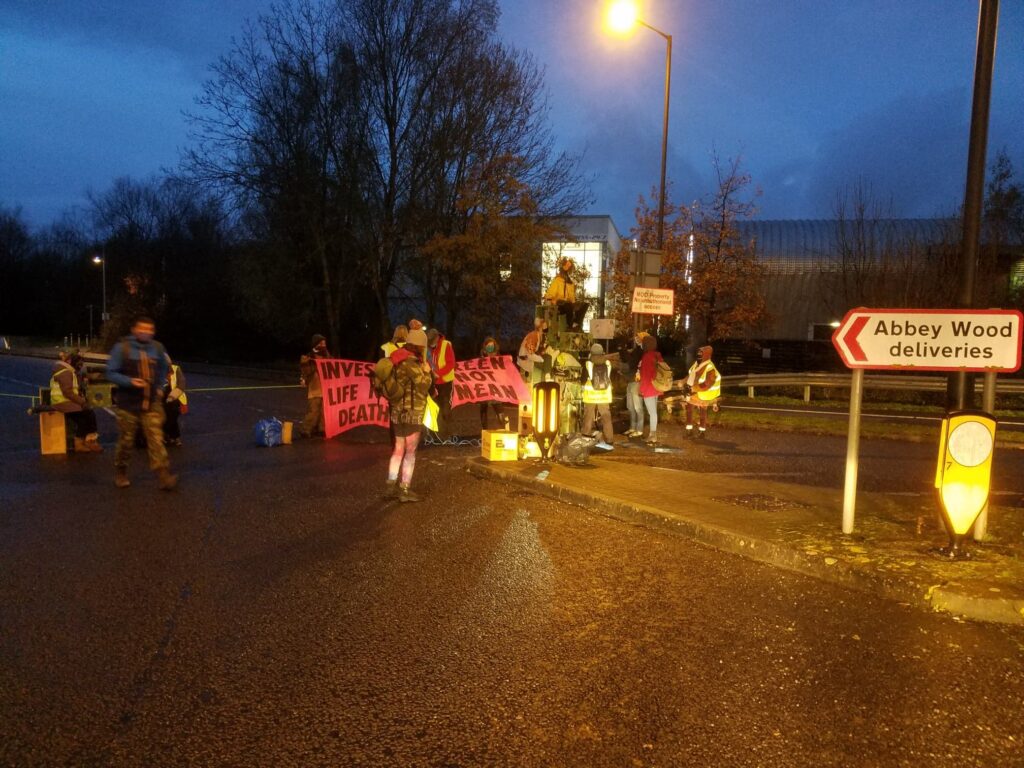
The blockade drew attention to what the protestors describe as the government’s “dangerously inadequate response” to the climate emergency. The Government has just committed £24 billion to military spending over the next 4 years, yet only £16 billion to their Climate Plan
Protester Reverend Sue Parfitt of Christian Climate Action, said “I don’t believe the answer to the ‘aggravated threats to international peace and security’ is to develop more sophisticated weapons. “We have to spend the money that’s needed on climate action. If we fail on this, the results will be unimaginable suffering.”

Sita Ruskin, of Bristol Extinction Rebellion, said “We’re here to say to our government: spend our money on combatting climate change – not on putting weapons into combat. Failing to take action on climate change is what will fuel war. It’s predicted that conflicts could increase by 10% to 20% for every half degree Fahrenheit increase in global temperatures.”
Police moved in to clear protesters by late morning. Quaker Gaie Delap and Reverend Sue Parfitt were arrested for obstruction of the highway and released later in the day. There was traffic disruption around the site for the rest of the day.

https://www.bristolpost.co.uk/news/bristol-news/extinction-rebellion-blockade-mod-abbey-4787780
Further information can be found at the new XR Peace Bristol facebook page www.facebook.com/xrpeacebristol/
Background information on the arms industry in north Bristol at https://bristolagainstarmstrade.wordpress.com/
Link to video of Interview about the shocking war machine in north Bristol https://www.facebook.com/rowland.dye/videos/10158574824296955
Nuclear disarmament : from ‘open-ended talks’ to ratification and beyond
Now the UN Treaty on the Prohibition of Nuclear Weapons is due to become international law, nuclear powers need to engage constructively on nuclear disarmament.
Rebecca Johnson, 28 Oct 2020, from OpenDemocracy.net
From the moment two atomic bombs killed two hundred thousand people in two split seconds over Hiroshima and Nagasaki seventy-five years ago, nuclear weapons have caused nightmares, environmental contamination, self-serving myths and abuses of power.
What will change now that the 2017 Treaty on the Prohibition of Nuclear Weapons (TPNW) is on the threshold of making nuclear weapons internationally illegal?
See also:
Church leaders urge UK government to sign UN anti-nuclear treaty (Guardian, 15 Nov 2020)
Treaty to ban nuclear weapons made official with 50th UN signatory (Guardian, 25 Oct 2020)
It is significant that the 90 day countdown to the legal entry into force of this multilateral nuclear disarmament Treaty was triggered by three nations (Honduras, Jamaica and Nauru) from the Global South. Symbolic too, that this occurred in time for the 50th ratification to be deposited with the UN Secretary General on 24 October, the 75th anniversary of the founding of the United Nations .
This Treaty Prohibiting Nuclear Weapons was brought about by “We the Peoples“, in direct opposition to the wishes of the nine nuclear armed governments, who desperately tried to stop the Treaty as negotiations opened in the UN General Assembly with rules that were developed by the UK and others to achieve the Arms Trade Treaty a few years earlier.
The UN rules ensured that all governments were invited to the table and no-one was given the power to veto. That made it possible for this Treaty to be negotiated and adopted by an overwhelming majority of states.
When I started writing a series of contemporaneous articles for openDemocracy on feminist approaches to security and disarmament in 2010, the International Campaign to Abolish Nuclear Weapons was a little known project of anti-nuclear doctors and activists in Australia. Treaty negotiations were controlled by a handful of governments that possessed nuclear weapons and wanted to keep control of the associated power and technologies for their own use.
The security and needs of the majority of nations who had decided to forego these weapons of mass extinction were barely taken into account.
Seventy years of campaigning by Japanese Hibakusha, such as Setsuko Thurlow and survivors of nuclear testing and colonialism, as well as generations of doctors, scientists and peace activists, culminated in UN ‘open-ended’ talks from 2013 that enabled far more people and governments to discuss how best to prevent the catastrophic consequences and risks of nuclear use and war. These in turn led to UN negotiations in 2017 that upended the privileges and assumptions of cold war arms control and made inroads into the nuclear club’s macho fiefdom.
Unable to block the negotiations or veto the Treaty, the nuclear armed states staged a boycott. Some, including three members of the UN Security Council, lined up their ambassadors in a weird demonstration outside the UN General Assembly as their colleagues from other countries streamed into the hall to begin the serious business of banning nuclear weapons.
Treaty negotiations were controlled by a handful of governments that possessed nuclear weapons and wanted to keep control of the associated power and technologies for their own use.
Three years later, we are celebrating that the Treaty Prohibiting Nuclear Weapons will become international law on January 22, 2021.
Making human security the objective of negotiations, instead of privileging military-industrial interests, has resulted in a powerfully different Treaty, based on humanitarian law and feminist security principles.
The preamble clearly sets out the shared security interests of the world’s peoples:
“… the catastrophic consequences of nuclear weapons cannot be adequately addressed, transcend national borders, pose grave implications for human survival, the environment, socioeconomic development, the global economy, food security and the health of current and future generations, and have a disproportionate impact on women and girls, including as a result of ionizing radiation…”
This leads to the core prohibitions on acquiring, developing, manufacturing, testing, deploying, transferring, possessing and using nuclear weapons. It is stipulated that everyone who is bound by the Treaty must also support its full implementation and avoid assisting, inducing or encouraging anyone else to violate its provisions in any way.
Having chosen to boycott the negotiations, the nuclear armed states complain that the Treaty is “dangerous” and doesn’t take their interests into account. In a last ditch derailing attempt, the Trump administration sent a letter and talking points to many governments. Arrogantly describing national decisions to join the Treaty as a “strategic error”, the letter tried to pressure them to pull out.
Among its talking points the US repeats its discredited accusation that the new Treaty undermines the 1968 Non-Proliferation Treaty (NPT) and complains that the text does not fully determine how its prohibitions and provisions will be verified and implemented.
On the contrary, the Treaty was overwhelmingly adopted by 122 NPT member states in 2017, and UN Secretary-General António Guterres recently described it as an important pillar to strengthen nuclear disarmament and nonproliferation.
Rooted in the humanitarian imperative to prevent nuclear use, war and proliferation, the Treaty Prohibiting Nuclear Weapons establishes the principles and conditions for these abhorrent weapons to be eliminated, with a set of practical, adaptable enforcement provisions.
The Treaty Prohibiting Nuclear Weapons establishes the principles and conditions for these abhorrent weapons to be eliminated, with a set of practical, adaptable enforcement provisions.
The legal, structural and institutional details will begin to be negotiated at the first meeting of TPNW states parties, which is scheduled to take place before the end of 2021, probably in Vienna, where both the International Atomic Energy Agency and the Comprehensive Test Ban Treaty are headquartered.
Similarly, the Treaty provided two practical pathways for nuclear armed and umbrella states to make choices in how they join and comply with the Treaty’s requirements that they end reliance on nuclear activities and eliminate these weapons, programmes and policies. Recognising that one size doesn’t fit all, and the nine nuclear arsenals are very different, the Treaty is deliberately constructed to enable the existing nuclear armed states and their nuclear umbrella allies to participate in the process as observers until they are ready to join.
The non-nuclear nations came together with humanitarian and disarmament experts and civil society activists to bring this ground-breaking nuclear disarmament treaty into international humanitarian law.
The UK
Here in Britain, we face an uphill struggle to persuade the government to halt the hugely expensive Dreadnought-Trident modernisation. However, public opinion polls show large majorities of British people in favour of nuclear disarmament and opposing Trident replacement, projected to cost £205 billion.
Public opinion polls show large majorities of British people in favour of nuclear disarmament and opposing Trident replacement, projected to cost £205 billion.
More and more, people are coming to see that nuclear weapons pose extinction level risks and are not a political or security asset. They are useless for tackling today’s major security challenges, including the climate, Covid and ecological emergencies.
The Scottish Government publicly endorses it and seeks to rid Scotland of Trident and end the dangerous transportation of warheads between Faslane, Coulport, and Berkshire’s bomb factories, Aldermaston and Burghfield.
With the Treaty close to entry into force, major international banks and financial institutions are beginning to divest from nuclear weapons production, informed by ICAN’s “Don’t Bank on the Bomb” campaign.
And a growing number of city and county councils, from Manchester and Edinburgh to Renfrewshire and Oxford, have signed up to support the Treaty’s implementation, with many more likely to follow in the next weeks and months.
Until there is a government able to take the necessary political decision to join the Treaty, it will be important to send UK diplomatic and scientific delegations to observe the TPNW meetings of states parties and contribute expertise and ideas as the legal, institutional and verification systems for Treaty implementation.
The House of Lords has urged this constructive approach, which previous UN governments have taken towards other important Treaties, even before taking the political decisions to join.
Former nuclear submariner asks: ‘Why Trident?’
New book published by Commander Rob Forsyth RN (Ret’d)
“The theory of nuclear deterrence is flawed, unproven and poses significant dangers from accidental use.”
Commander Robert Forsyth

Commander Rob Forsyth RN (Ret’d), former Executive Officer of the Polaris missile submarine HMS Repulse in the 1970s, was one of the front-line custodians of the UK’s nuclear deterrent at the height of the Cold War.
In common with a number of his peers, Commander Forsyth has grown increasingly concerned about the state into which the Royal Navy has declined as a result of successive cuts in spending. Whilst spending has been cut on conventional forces, one part of the budget has continued to grow – the proportion spent on maintaining the UK’s nuclear deterrent.
Following extensive research, now published in the book Why Trident? (Spokesman, 2020), Commander Forsyth concludes: “Some serious questions need to be asked by the national political and military leadership about not only the affordability, but also the necessity, of the UK’s nuclear deterrent.”
Commander Forsyth has journeyed from the depths of the Cold War and acceptance of ‘nuclear deterrence’ to a rejection of that concept and opposition to renewal of the Trident nuclear weapon system.
His new book details this journey, reveals the findings of his research and stands as a testament to what can be unleashed when the “habit of conformity” is eroded and a determined search for answers is embarked upon.
In his foreword to the book, Vice Admiral Sir Jeremy Blackham KCB MA, writes: “Few people have examined more rigorously the critical questions surrounding the nuclear element of [the] ‘continuum of deterrence’ than Rob Forsyth. I am very glad that his work in this field has been collected into this book. All those involved in this field should read and carefully reflect on what he has to say.”
In his introduction to the book, Professor Nick Grief (Emeritus Professor of Law at the University of Kent and an Associate Tenant at Doughty Street Chambers) writes: “What comes through from Commander Forsyth’s personal reflections is a dogged determination to get at the truth about nuclear deterrence, to expose the policy’s shortcomings and, despite ‘lengthy but ultimately frustrating correspondence with the MoD’, to go on asking questions about the legal and moral implications of the Government’s position”
Further information:
Commander Forsyth’s website, www.whytrident.uk, is a valuable source of information which includes most of the text included in the book and further biographical materials.
Spokesman Books is the publishing imprint of the Bertrand Russell Peace Foundation. Lord
Russell established the Foundation in 1963 to continue his work for peace, human rights and social justice. See www.spokesmanbooks.com for further information
Purchase direct through www.whytrident.uk or from your favourite book retailer.
Submission from XR Peace to the Government’s “Integrated Review Call for Evidence 2020”
Submissions of evidence were invited to inform the government’s Integrated Review of Security, Defence, Development and Foreign Policy.
XR Peace Submission (pdf)
Climate Justice Now – End Militarism!
Militarism and War Cause Climate Destruction
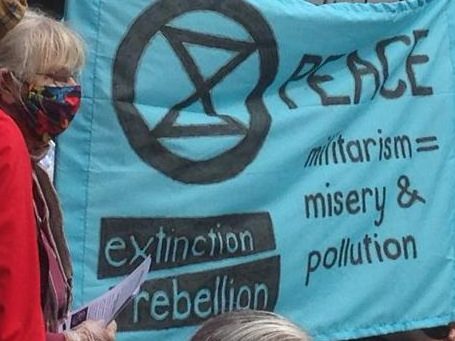
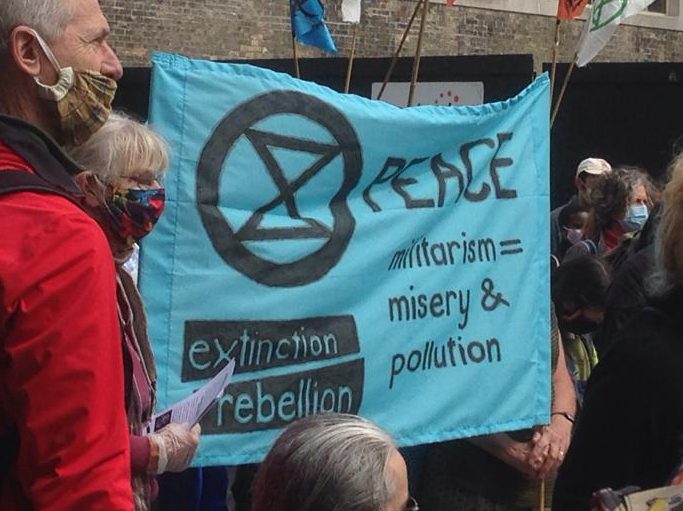
XR Peace is a movement within Extinction Rebellion that especially highlights the military causes and impacts of climate chaos. We take action for Peace, Disarmament, Human Rights, Real Security and Climate Justice.
Climate Justice and war have the same root causes as structural inequality, racism and violence against women. They are the consequences of military-industrial systems of unsustainable growth, profit, aggression and exploitation.
Armed conflict and weapons contribute to poverty and cause great misery and death. Refugees flee their homes. Climate chaos makes everything worse. When things go wrong, the most vulnerable are at greatest risk. Women and children inevitably pay the highest price.
In March 2020, as Covid-19 spread around the world, UN Secretary-General António Guterres called for a global ceasefire saying: “It is time to put armed conflict on lockdown and focus together on the true fight of our lives.”
That means working together locally and globally to tackle the climate emergency and build up everyone’s health, care and education services. We have to reduce all weapons and military budgets, and develop effective, nonviolent ways to share resources and resolve our conflicts together. Care work and sustainable jobs are Green jobs.
There is No Planet B – Protect the Home We Share
Climate Chaos and Nuclear Weapons Pose Huge Dangers to our Environment and Security Every Day
Around $100 billion per year is spent on 13,400 nuclear weapons held by 9 nuclear states.
Detonating just a few of these nuclear WMD would add catastrophically to climate destruction and cause billions of initial survivors to die. Not only of radiation sickness, but of starvation all over the world.
The Greenhouse gas (GHG) emissions of UK weapons production and military spending in 2018 was 11 million tonnes of CO2 equivalent, as calculated by Scientists for Global Responsibility. BAE Systems produced 30% of these annual UN military-related emissions.
Make Urgent Changes Now to Create Real Security, Before it’s too late
- Rebel for Life, Peace and Climate Justice
- End Militarism and develop effective peace-building ways and means to resolve conflict among people and nations.
- Reduce our Carbon footprints, eg through local and national Green New Deal policies, practices and economic steps to create sustainable jobs and to limit and share the resources we need.
- Boycott and divest from all companies that enable, develop, make or sell weapons. Instead support ban treaties like the 2017 Treaty on the Prohibition of Nuclear Weapons.

We Want to Live: UK Rebellion 1st September 2020
The Rebellion Goes to Parliament
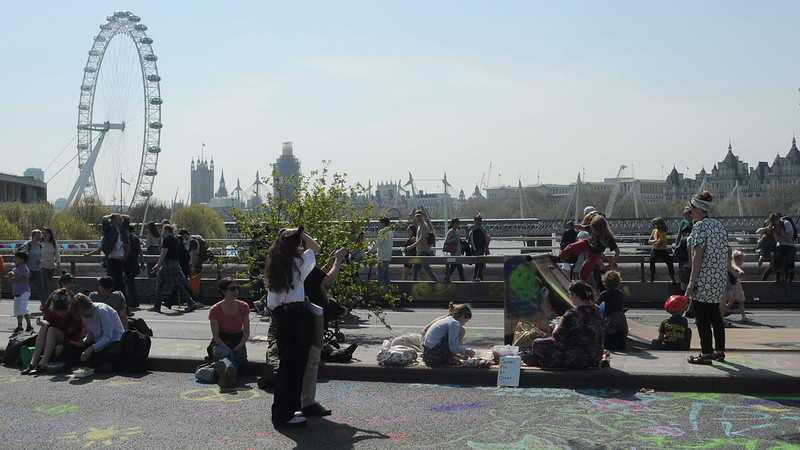
On 1st September the UK Parliament starts re-sitting after the summer: so Extinction Rebellion UK are going to make sure they start anew with justice, care and life at the heart of it.
From the 1st XR will peacefully disrupt the UK Parliament in London, carrying out pressure building actions over two weeks, until they back the Climate and Ecological Emergency Bill and prepare for crisis with a National Citizens’ Assembly.
The Rebellion will not just be focused on London though. Rebels will also join us in disruption of Cardiff and Manchester. These rebellions are open to all!
Find out how to engage and be a part of the Rebellion
We Want to Live: Climate Not Trident – CND’s August Bank Holiday weekend action
XR Peace are unable to participate as a movement within XR for this Rebellion – But XR Peace individuals are encouraged to get involved by forming their own autonomous groups or with other XR groups attending the Rebellion.
September Rebellion Facebook Event
Healing Not Killing – 75 years since the atomic bombing of Hiroshima and Nagasaki
REPORT OF THE 2020 INTERNATIONAL PEACE FAST IN KNIGHTON

As part of Trident Ploughshares and XR Peace, 2 women (Angie Zelter and Lyn Gardenchild), fasted over 4 days to grieve and commemorate the atomic bombings of Hiroshima and Nagasaki.
They prepared 4 exhibition boards with information about the bombings, the 9 nuclear weapon states, the Treaty to Prohibit Nuclear Weapons, XR Peace and the impact of the military on climate chaos.
On each of the 4 days the boards, banners, and tables for leaflets and crane making were set up at 7.30 a.m. and then taken down at 6 p.m. Social distancing was adhered to although family clusters were closer. More than 50 different people visited the fast to view the exhibition, take part in the workshops or play music. Some people attending fasted for a day or missed a meal in solidarity and £188.80 was raised for the Knighton Food Bank.
The opening ceremony on Thursday 6th August at 8,15 a.m. was attended by around 13 people and there were readings from the Hiroshima Hibakusha and a bell from Hiroshima was rung.
Tod (on violin) and Camilla (on accordion) played for an hour while the knitting of white poppies began. This was followed by Baptist Minister Rev.Kevin Dare leading a workshop entitled ‘Is there any real hope for peace?’ We concluded that there was! He was joined by other local ministers representing the Church of Wales (Rev. Petra Goodband) and the Catholic Church (Father Jerome) and between them they led Prayers for Peace.
The atmosphere of the fast was lovely, calm and welcoming. At 3 p.m. Penny Rosenthal led a workshop on Maslow’s pyramid on the constituents of security and people joined in making themselves heard even over the very loud traffic noises.
Friday 7th August found the knitters fast at work and a young family came along and the father bought 2 of the poppies for his children. Christine (on whistle) along with Tod (on violin) made the time pass very pleasantly and intrigued passers by. The morning workshop led by John Goodband was fairly technical and explored the peaceful uses of radiation in cancer treatment, ending with a plea for just a fraction of the money spent on Trident to pay for more healing equipment.
The afternoon workshop led by Angie Zelter was on the impact of climate change on our security. The participants told us of the changes in climate they had observed locally and in the world at large and came up with lots of suggestions on how our local environment would be made more resilient and secure. Shadows were chalked on the ground – many people were unfamiliar with this tradition that symbolizes the shadows found on pavements in Hiroshima – the only remains of the people burnt into the ground by the heat of the explosion.
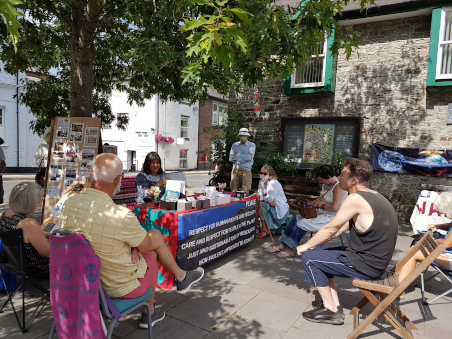
Saturday 8th August the peace crane making started really early and 3 strings of cranes were hung in the branches of the pin oak that was scattering us with beautiful flattened acorns. Charlie (on guitar) played for us, despite a badly cut thumb, and was then joined by John (who drummed on the guitar case and the Hiroshima bell).
Rev. Petra Goodband then gave a workshop giving us an insight into what a variety of different faiths said about nuclear weapons. Most outlawed indiscriminate weapons that killed civilians.
The afternoon workshop, led by Nandita Dowson on the Israeli annexation of Palestinian lands was very informative and lively and engendered much discussion.
Nagasaki day, 9th August, began quietly with Camilla (on accordion) and Chris (on flute).
11.01 a.m. began with John drumming. About 16 people gathered in a socially distanced circle to hear about the Nagasaki tragedy, a song was sung, a poem read, tears were shed.
But the good news was shared that on Hiroshima Day, 3 more States ratified the The U.N. Treaty on the Prohibition of Nuclear Weapons – Ireland, Nigeria, and Niue – and on this Nagasaki day Saint Kitts and Nevis also ratified. There are therefore now 44 States Parties.
There are only another 6 needed for the Treaty to come into force. We ended with a socially distanced group hug.