ICAN report shows increased spending on Nukes

In its report “Surge: 2023 Global Nuclear Weapons Spending” the International Campaign to Abolish Nuclear Weapons shows in 2023, the nuclear-armed states spent $91.4B on their arsenals – equivalent to $2,898 a second.

ICAN won the Nobel Peace Prize in 2017. Profits associated with the nuclear arms industry was $7.9B in 2023 with at least $6.3 million spent on influencing governments and public opinion on nukes.

It estimated that 2,100 nuclear warheads (mostly US or Russia) were in a state of “high operational alert”

The biggest spenders were the US, China and Russia. UK spending was up 17% for the second year in a row to $8.1B.

SIPRI’s director Dan Smith said “Regrettably, we continue to see year-on-year increases in the number of operational nuclear warheads” and that the trend will likely accelerate in the coming years.

The head of ICAN, Melissa Parke, said the money spent on nuclear arms was more than what the World Food Programme needs to end world hunger.

https://www.icanw.org/global_nuclear_weapons_spending_surges_to_91_4_billion

Also see reports and video on DW News: https://www.dw.com/en/nukes-spending-rises-amid-growing-global-tensions-studies/a-69380756

Lakenheath Alliance for Peace Calling For Your Support

Visit the Lakenheath Alliance for Peace website

Calling For Your Support – LAKENHEATH ALLIANCE for PEACE

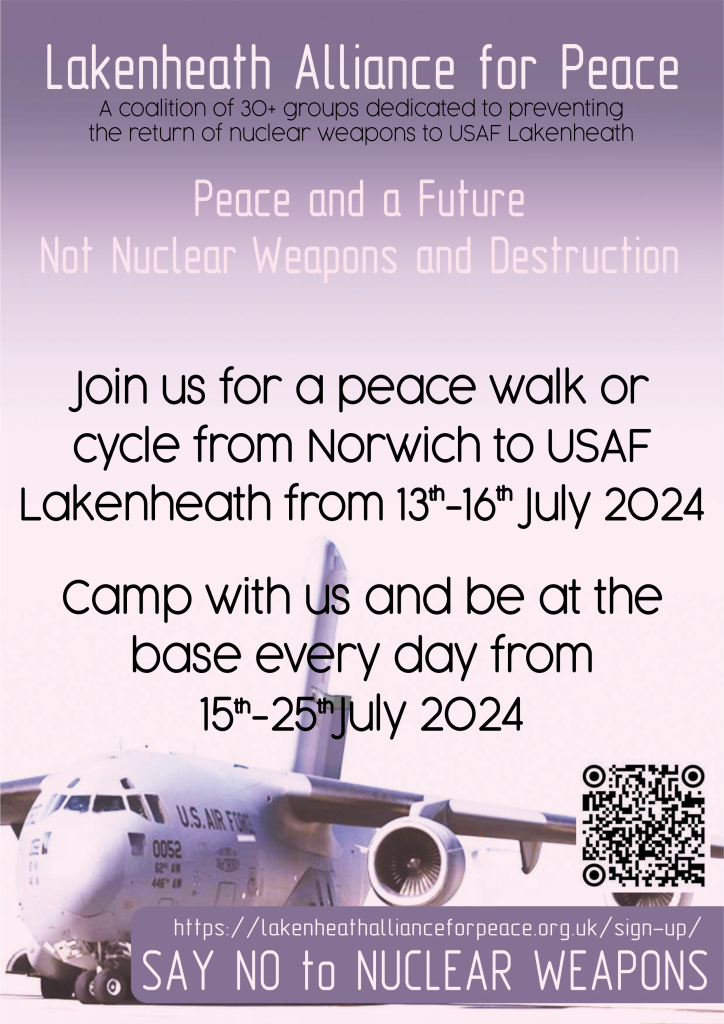
There are advanced plans to deploy American nuclear weapons to USAF/RAF Lakenheath, Suffolk. Infrastructure to house troops and to defend storage facilities and shelters is underway. Plus all sorts of other things we won’t know about. RAF Lakenheath is also the home to the USAF’s 48th Fighter Wing, the only unit in Europe, which operates both the F-15E Eagle and the F-35A Lighting II fighter aircraft. USA and Israel are also using UK air bases to move weapons to Israel to be used in their war against Hamas in Gaza, Palestine. Jet fighters in particular and militarism in general fuel climate change.

We must try and stop these weapons coming to USAF/RAF Lakenheath, or anywhere in the UK. We must raise awareness with the general public about what is happening. We therefore want to build an alliance of as many organisations and individuals as possible to create a powerful objection to US nuclear weapons returning to the UK.

Over 30 groups have already formed an alliance ‘Lakenheath Alliance for Peace’ including CND, Stop the War, WILPF, Greenham Women Everywhere, MAW, No to NATO, Trade Union Councils, Women in Black, Trident Ploughshares, XR Peace etc etc. More groups are joining every week. See https://lakenheathallianceforpeace.org.uk/about-us/alliance- organisations/

We are now inviting more groups to sign up with us. There are also many international peace activists interested in joining us. Please let us know as soon a possible if your group would like to join the Lakenheath Alliance for Peace as we need as many groups as possible to stop this nuclear escalation.

We launched LAP at the gates of USAF/RAF Lakenheath on March 26th delivering a letter to the base commander to demand No deployment of Nuclear Weapons at Lakenheath.

Our main event will start in Norwich on Saturday 13th July, when supporters will walk or cycle from Norwich to Lakenheath to raise awareness. Arriving on 15th July a camp will be set up and vigils, demonstrations and peaceful direct action will take place over the next week or so. Likely end of the camp will be 25th July depending on support.

WILL YOU SUPPORT AND JOIN US? In person; providing practical support; with publicity and raising awareness; getting demonstrations or meetings set up in your areas to coincide with any events or news coverage…ANYTHING to raise awareness about what is happening and that together we can stop US nuclear weapons from being based in the UK once again.

You can let us know of your support and be added to our mailing list by going to https://lakenheathallianceforpeace.org.uk/2024/03/16/sign-up/

With your help we are going to produce leaflets, banners and other informative materials to support what we are all doing.

WE HOPE WE CAN ADD YOUR LOGO to any materials we produce. The more organisations giving support from as wide a range of interests as possible, the better. This will give a coherent and strong statement about STOPPING the return of nuclear weapons to Lakenheath.

Please get in touch to ask for any further information and please let us know:-
a) Are you willing to be a named group in our Lakenheath Alliance for Peace (LAP)?
b) If so, please provide your group’s full name and email address, your mission statement and your logo if you have them.
c) Provide name & email of 1 person to represent your group and be the main communicator for your group who will be added to an email list for joint communications about LAP.

Best Wishes, Ali, Angie, Ginnie and Sue, lap@gn.apc.org

Hidden carbon costs of the “everywhere war”: Logistics, geopolitical ecology,and the carbon boot-print of the US military – Belcher et al

As climate change gathers pace, it is critical to assess how the world’s largest institutions contribute to global environmental change. In this paper, we analyse the United States military’s impact on the climate by exploring the hidden carbon costs of the “everywhere war” (Gregory, 2011).

Despite the Trump Administration’s announcement to withdraw from the 2015 Paris Agreement, the US military has long understood that it is not immune from the potential consequences of climate change (see US Department of Defense, 2014), nor has it completely ignored its own contribution to the problem.

The US military sees climate change as a “threat multiplier,” or a condition that will exacerbate other threats, and is fast becoming one of the leading federal agencies in the United States to invest in research and adoption of renewable energy (Gilbert, 2012). These investments include solar and biofuels, as well as reinforcing base infrastructure to mitigate the effects of sea‐level rise (Bigger & Neimark, 2017).

Nevertheless, the US military’s climate policy remains fundamentally contradictory. While the military confronts the effects of climate change, it remains the largest single institutional consumer of hydrocarbons in the world (Nuttall et al.,2017).


[download pdf]

Climate being wrecked by Global Military Spending and armed conflicts raging around the World

SIPRI: Global military spending surges amid war, rising tensions and insecurity

(Stockholm, 22 April 2024) Total global military expenditure reached $2443 billion in 2023, an increase of 6.8 per cent in real terms from 2022. This was the steepest year-on-year increase since 2009. The 10 largest spenders in 2023—led by the United States, China and Russia—all increased their military spending, according to new data on global military spending published today by the Stockholm International Peace Research Institute (SIPRI), available at www.sipri.org.

Military expenditure increases in all regions

World military expenditure rose for the ninth consecutive year to an all-time high of $2443 billion. For the first time since 2009, military expenditure went up in all five of the geographical regions defined by SIPRI, with particularly large increases recorded in Europe, Asia and Oceania and the Middle East. 

‘The unprecedented rise in military spending is a direct response to the global deterioration in peace and security,’ said Nan Tian, Senior Researcher with SIPRI’s Military Expenditure and Arms Production Programme. ‘States are prioritizing military strength but they risk an action–reaction spiral in the increasingly volatile geopolitical and security landscape.’

Military aid to Ukraine narrows spending gap with Russia 

Russia’s military spending increased by 24 per cent to an estimated $109 billion in 2023, marking a 57 per cent rise since 2014, the year that Russia annexed Crimea. In 2023 Russia’s military spending made up 16 per cent of total government spending and its military burden (military spending as a share of gross domestic product, GDP) was 5.9 per cent. 

Ukraine was the eighth largest spender in 2023, after a spending surge of 51 per cent to reach $64.8 billion. This gave Ukraine a military burden of 37 per cent and represented 58 per cent of total government spending.

Ukraine’s military spending in 2023 was 59 per cent the size of Russia’s. However, Ukraine also received at least $35 billion in military aid during the year, including $25.4 billion from the USA. Combined, this aid and Ukraine’s own military spending were equivalent to about 91 per cent of Russian spending.

USA remains NATO’s major spender but European members increase share

In 2023 the 31 NATO members accounted for $1341 billion, equal to 55 per cent of the world’s military expenditure. Military spending by the USA rose by 2.3 per cent to reach $916 billion in 2023, representing 68 per cent of total NATO military spending. In 2023 most European NATO members increased their military expenditure. Their combined share of the NATO total was 28 per cent, the highest in a decade. The remaining 4 per cent came from Canada and Türkiye.

‘For European NATO states, the past two years of war in Ukraine have fundamentally changed the security outlook,’ said Lorenzo Scarazzato, Researcher with SIPRI’s Military Expenditure and Arms Production Programme. ‘This shift in threat perceptions is reflected in growing shares of GDP being directed towards military spending, with the NATO target of 2 per cent increasingly being seen as a baseline rather than a threshold to reach.’

A decade after NATO members formally committed to a target of spending 2 per cent of GDP on the military, 11 out of 31 NATO members met or surpassed this level in 2023—the highest number since the commitment was made. Another target—of directing at least 20 per cent of military spending to ‘equipment spending’—was met by 28 NATO members in 2023, up from 7 in 2014.

China’s rising military expenditure drives up spending by neighbours

China, the world’s second largest military spender, allocated an estimated $296 billion to the military in 2023, an increase of 6.0 per cent from 2022. This was the 29th consecutive year-on-year rise in China’s military expenditure. China accounted for half of total military spending across the Asia and Oceania region. Several of China’s neighbours have linked their own spending increases to China’s rising military expenditure. 

Japan allocated $50.2 billion to its military in 2023, which was 11 per cent more than in 2022. Taiwan’s military expenditure also grew by 11 per cent in 2023, reaching $16.6 billion.

‘China is directing much of its growing military budget to boost the combat readiness of the People’s Liberation Army,’ said Xiao Liang, Researcher with SIPRI’s Military Expenditure and Arms Production Programme. ‘This has prompted the governments of Japan, Taiwan and others to significantly build up their military capabilities, a trend that will accelerate further in the coming years.’

War and tensions in the Middle East fuel biggest spending increase of past decade

Estimated military expenditure in the Middle East increased by 9.0 per cent to $200 billion in 2023. This was the highest annual growth rate in the region seen in the past decade. 

Israel’s military spending—the second largest in the region after Saudi Arabia—grew by 24 per cent to reach $27.5 billion in 2023. The spending increase was mainly driven by Israel’s large-scale offensive in Gaza in response to the attack on southern Israel by Hamas in October 2023. 

‘The large increase in military spending in the Middle East in 2023 reflected the rapidly shifting situation in the region—from the warming of diplomatic relations between Israel and several Arab countries in recent years to the outbreak of a major war in Gaza and fears of a region-wide conflict,’ said Diego Lopes da Silva, Senior Researcher with SIPRI’s Military Expenditure and Arms Production Programme. 

Military action against organized crime pushes up spending in Central America and the Caribbean

Military spending in Central America and the Caribbean in 2023 was 54 per cent higher than in 2014. Escalating crime levels have led to the increased use of military forces against criminal gangs in several countries in the subregion.

Military spending by the Dominican Republic rose by 14 per cent in 2023 in response to worsening gang violence in neighbouring Haiti. The Dominican Republic’s military spending has risen steeply since 2021, when the assassination of Haitian President Jovenel Moïse threw Haiti into crisis.

In Mexico, military expenditure reached $11.8 billion in 2023, a 55 per cent increase from 2014 (but a 1.5 per cent decrease from 2022). Allocations to the Guardia Nacional (National Guard)—a militarized force used to curb criminal activity—rose from 0.7 per cent of Mexico’s total military expenditure in 2019, when the force was created, to 11 per cent in 2023.

‘The use of the military to suppress gang violence has been a growing trend in the region for years as governments are either unable to address the problem using conventional means or prefer immediate—often more violent—responses,’ said Diego Lopes da Silva, Senior Researcher with SIPRI’s Military Expenditure and Arms Production Programme.

Other notable developments

  • India was the fourth largest military spender globally in 2023. At $83.6 billion, its military expenditure was 4.2 per cent higher than in 2022.
  • The largest percentage increase in military spending by any country in 2023 was seen in the Democratic Republic of the Congo (+105 per cent), where there has been protracted conflict between the government and non-state armed groups. South Sudan recorded the second largest percentage increase (+78 per cent) amid internal violence and spillover from the Sudanese civil war.
  • Poland’s military spending, the 14th highest in the world, was $31.6 billion after growing by 75 per cent between 2022 and 2023—by far the largest annual increase by any European country.
  • In 2023 Brazil’s military spending increased by 3.1 per cent to $22.9 billion. Citing the NATO spending guideline, members of Brazil’s Congress submitted a constitutional amendment to the Senate in 2023 that aims to increase Brazil’s military burden to an annual minimum of 2 per cent of GDP (up from 1.1 per cent in 2023).
  • Algeria’s military spending grew by 76 per cent to reach $18.3 billion. This was the highest level of expenditure ever recorded by Algeria and was largely due to a sharp rise in revenue from gas exports to countries in Europe as they moved away from Russian supplies.
  • Iran was the fourth largest military spender in the Middle East in 2023 with $10.3 billion. According to available data, the share of military spending allocated to the Islamic Revolutionary Guard Corps grew from 27 per cent to 37 per cent between 2019 and 2023.

The Case Against Trudi Warner Puts Justice on Trial

By Jennine Walker, Good Law Project
18 April 2024

Why is the solicitor general attacking our fundamental rights? The reasons are both inside and outside the courtroom.

Sometimes Trudi Warner wonders if she will wake up from a dream and find she really has committed some terrible crime that would merit two years in jail. But she has done nothing wrong.

In March last year, Trudi stood outside Inner London Crown Court holding a placard which said “Jurors: You have an absolute right to acquit a defendant according to your conscience.” The judge ordered this 68-year-old retired social worker to be arrested and to appear at the Old Bailey for “attempting to influence the jury”. The solicitor general started proceedings against Trudi in September, and she will appear in court today so that a judge can decide whether they will go ahead to a full hearing. If she is found in contempt of court she could be sent to prison for two years.

Jurors must reach their verdicts based on the evidence they hear in court, but they also have the power to decide cases according to what they think is right. This is the fundamental principle of our common law that Trudi’s placard declares, a principle which dates back to the 17th century. Juries exist to keep the power of the state in check. Twelve citizens, selected at random, will have a collective experience of life far greater and more diverse than any individual. Juries must follow the directions of a judge and respect the law, but – as Lord Devlin said in 1991 – there may be certain cases when “their respect for the law is overridden by the conviction that to punish would be unjust”. When the law is too far from justice, juries can decide that justice should prevail. This is a vital safeguard in our democracy.
Good Law Project is powered by people across the UKDonate now

The solicitor general – a conservative minister who advises the government on the law – is attacking this crucial principle and trying to put Trudi behind bars because of what was happening in that hearing at the Inner London Crown Court, and because of a much, much wider story about our changing world.

Trudi was standing outside a courtroom where people were on trial for causing a public nuisance by sitting in a road to protest at the government’s failure to tackle the climate crisis. They were demanding that the government take urgent action to insulate homes and reduce carbon emissions. But the judge wouldn’t let them tell the jury why they were protesting, banning them from even mentioning the words “climate change” or “fuel poverty”.

In 2019, parliament declared that the UK is facing an environmental and climate emergency, recognising the “devastating impact that volatile and extreme weather will have on UK food production, water availability, public health and through flooding and wildfire damage”. Yet despite the extreme heatwaves, floods and fires we have seen since then, the government is falling behind its own legally-binding plan to hit net zero. Instead they’ve been handing out new licenses in the North Sea and passing new laws to silence people, like Trudi, who peacefully protest.

The solicitor general’s case against Trudi is chilling evidence of how far removed this government is from truth and justice. But it also shows the power we have when we come together. Inspired by Trudi’s action, hundreds of people have already stood outside other courts holding the same sign. In support and solidarity, they have written to the solicitor general saying he should bring contempt proceedings against them too. Whatever happens in Trudi’s case, we will continue to protest, peacefully, calling on the government to do more to tackle the climate emergency. At Good Law Project, we are proud to stand with Trudi.

Lakenheath Alliance for Peace

XR Peace has joined the newly formed Lakenheath Alliance for Peace (LAP). LAP is a coalition of groups that is dedicated to preventing the return of US Nuclear weapons to USAF Lakenheath. It is committed to nonviolent direct action for a peaceful and non-threatening world.

It demands that military resources are instead directed towards global peace and justice and the prevention of human caused climate change and biodiversity loss. XR Peace will be joining the peace camp at Lakenheath in the summer and hope that many XR Peace supporters will join in. A website is in the process of being built at
https://lakenheathallianceforpeace.org.uk and the email is lap@gn.apc.org

ICAN: Second meeting of states parties agrees nuclear deterrence is the problem

[From www.icanw.org]

The Second Meeting of States Parties to the TPNW has successfully concluded and agreed that nuclear deterrence is a significant security problem, requiring urgent attention by the international community, that more research on the impacts of nuclear weapons is needed, and that the harms caused by nuclear weapons use and testing require ongoing attention.

94 countries participated in the meeting as states parties or observers including some that currently endorse the use of nuclear weapons in their defence doctrines. These countries engaged in a robust and interactive debate during the week, adopting a political declaration and package of decisions.

Nuclear deterrence is a cause of global instability and insecurity

One of the adopted decisions included, for the first time ever, an agreement to work together to challenge the false narratives of nuclear deterrence. States parties mandated states, the International Committee of the Red Cross and ICAN and other stakeholders and experts, “To challenge the security paradigm based on nuclear deterrence by highlighting and promoting new scientific evidence about the humanitarian consequences and risks of nuclear weapons and juxtaposing this with the risks and assumptions that are inherent in nuclear deterrence.” 

There remains an information gap between what would actually happen as a result of nuclear war and the policies of the nuclear-armed states and their allies, and efforts to bridge this gap are the primary responsibility of those whose policies include the use of nuclear weapons. 

New evidence on the impacts of nuclear weapons demand action from the global community

New research was presented during the meeting as well, including findings showing that based on current understandings of arsenal sizes and effects on human beings, a nuclear war between the US and Russia would likely result in about 90 million casualties from blast, heat, fire, and radiation from hundreds of explosions across the northern hemisphere.

There is much greater understanding of the cascading effects on food supplies, the financial system and energy supplies that help us better predict the likely effects of nuclear detonations.

It was understood that research alone cannot reduce the risks of nuclear weapons, but that it can inform the public and policy makers about the harm existing in their arsenals or security doctrines. 

Additionally, the Scientific Advisory Group presented research findings showing that  the elimination of nuclear weapon facilities is possible and that there are ways to achieve conversion of facilities to civilian use; and there are ways to develop processes for arms control, such as weapon counting and warhead authentication.

Importantly, the Scientific Advisory Group also called for a new UN study on the consequences of nuclear war given the last comprehensive studies were done in the late 1980s.

Centring affected communities

The states heard testimony from members of communities affected by the use, testing and development of nuclear weapons, and heard their calls for recognition by governments of the harms they did to people, particularly Indigenous peoples.

They also heard about the efforts made so far to repair the damage that has scarred people and the land, as well as to open official records and do more research on the health impacts and environmental impacts of nuclear weapons.

These representatives, supported by wider civil society, called for the clean up and remediation of lands – through Articles 6 and 7 of the TPNW – in which Indigenous peoples must be involved as the Traditional Owners, and research on nuclear weapon impacts on intangible cultural heritage.

A joint statement endorsed by 26 nuclear affected community-led organisations, and supported by a further 45 allied organisations  said “We have the right and responsibility to speak about what nuclear weapons really do… We call on States Parties to the TPNW to push relentlessly for its universalisation.”

Other stakeholders

A delegation of 23 parliamentarians from 14 countries mostly from countries that are yet to sign the treaty met on the margins of the conference, and delivered a statement denouncing nuclear threats while urging governments to sign and ratify the treaty urgently.

The financial community was also present, delivering a joint statement by more than 90 investors, representing over $1 trillion in assets under management, encouraging states to work with the financial community to further strengthen the norms and objectives of the treaty, including by ending financing relationships with the nuclear arms industry.

During the week, more than 65 events, including art exhibitions, concerts, panel discussions, awards ceremonies and more were held on the margins of the meeting. 

The Third Meeting of States Parties to the treaty will take place 3-7 March, 2025 in New York.

Israel/Palestine Conflict

Also see page about the Israel/Palestine Conflict

The World’s Most Documented Genocide in History. By Lara Elborno. 4 Jan 2024

‘Are we the baddies?’ By Jonathan Cook. 27 Dec 2023

The Worst Day in Gaza. DDN Video 13 Dec 2023

How Israel uses an AI genocide program to obliterate Gaza. Jonathan Cook. 5 Dec 2023

U.S. Military Satellites Over Gaza. YouTube. 29 Nov 2023

Why Does The UK Give Israel Unqualified Backing. By Mark Curtis. 21 Nov 2023

Don’t be fooled. By Jonathan Cook. 15 Nov 2023

Condemn if you wish, but Palestinians will pay a heavy price. By Jonathan Cook. 10 Nov 2023

What the BBC fails to tell you about October 7. By Jonathan Cook. 2 Nov 2023

Mounting evidence suggests Israel may be ready to ‘cleanse’ Gaza. By Jonathan Cook. 1 Nov 2023

Former British Soldier Exposes Israel War Machine. By Joe Glenton. DDN Patreon video. 31 Oct 2023

With Hamas gone, Gaza still wouldn’t be free. By Jonathan Cook. 28 Oct 2023

UK Charities Call for Immediate Ceasefire, Humanitarian Aid and Lifting Siege on Gaza.
27 Oct 2023

The Palestinian people have a right to their lives, land and sovereignty. By GRAIN. 27 Oct 2023

ICC statement on the Israel-Palestine war (International Coordinating Committee). 26 Oct 2023

Israel Killed 30 Members of My Family in 2 Days. By Yara Edi. DDN Patreon video. 25 Oct 2023.

Statement on the Palestine/Israel conflict by Safe Passage. 24 Oct 2023

Queen Rania criticizes West’s ‘blatant double standards’: “We are witnessing a massacre in Gaza”. YouTube. 24 Oct 2023

King Abdullah’s speech at the recent Cairo Peace Summit. Facebook video. 22 Oct 2023.

Interview with Israeli journalist Amira Hass. Facebook video. 20 Oct 2023.

Israel is a Terrorist State by Matt Kennard. Double Down News. 18 Oct 2023.

Jewish Currents: A Textbook Case of Genocide. By Raz Segal. 13 Oct 2023.

Gabor Mate explains how he sees the Palestine Israël conflict. YouTube. 8 Oct 2023